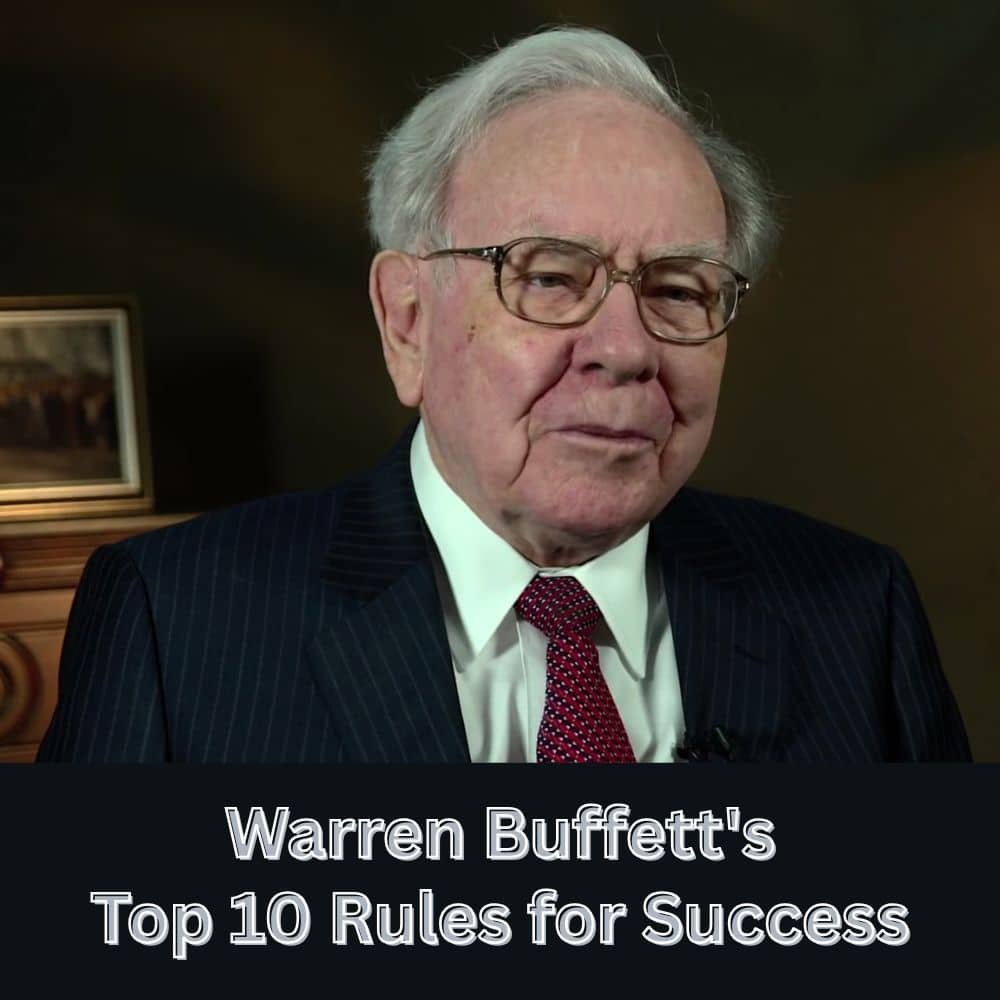
Warren Buffett’s Top 10 Rules for Success to Inspire You

Warren Buffett's Top 10 Rules for Success

Today, I offer you Warren Buffett’s Top 10 Rules for Success, dear reader.

If you want success, then it would be wise to listen to people who have already achieved some success.

Identify what they did to achieve their success and copy it.

If it worked for them, then it will probably work for you.

Now, there are few people more successful in their chosen field than Warren Buffett.

He offers you his ‘Top 10 Rules for Success’ in the video embedded here, and it’s worth your time to listen to him.

They are his top tips, and I recommend them to you.
Make Money

Warren Buffett’s Top 10 Rules For Success:

Please share this post with your friends:

If you found this article useful, then please share it on social media with your friends.

When you share, everyone wins.

So go on, please share it now.

If you can do that for me, I’ll be forever grateful, and you’ll be helping a keen blogger reach a wider audience.

Your support is appreciated, dear reader. Thank you.

Phil Sutton

Articles you might find interesting:

Creating a Life Plan: 17 ways the rich think differently

Today I am exploring the idea of creating a life plan.

Creating a Life plan
Make Money

Have you ever thought about creating a life plan, dear reader? If you’re young and have your life ahead of you, certainly, it’s a good idea. You can always let life happen to you, of course, but it’s better if you go out and make life happen the way you’d prefer it to be. And to have a good life, having money certainly helps. So money is at the heart of life planning.

Now, why is it that some people are wealthy and others are not?

You might argue that the rich inherit money, and therefore, they’re just lucky. For a few people, that may be true. However, it’s not a universal truth.

Having wealthy parents helps, no doubt, but there are plenty of examples of self-made millionaires and billionaires. And there are plenty of examples of people who lost all their wealth and then just created another fortune.

There are also plenty of examples of poor people who enjoyed good fortune winning a lottery only to squander their millions within a few short years.

This would suggest that the rich and poor have different philosophies concerning creating a life plan and money as a resource.

17 ways the rich and poor think differently:

The video embedded here explores 17 ways in which rich people and poor people think differently. It’s an interesting video, and it makes some really useful points that will help you in your life planning. It’s informative and well worth a few minutes of your time, in my opinion.

Please share this post with your friends:

If you found this article and the video useful, then please share this post on social media with your friends.

When you share, everyone wins.

So go on, please share this post now. If you do, I’ll be ever so grateful. You’ll be helping a keen blogger reach a wider audience, and that’ll be your good deed for the day.

Thank you for your support.

Phil Sutton

How to build wealth from nothing: 5 Top Tips

There’s nothing you can do about being born poor. If that was the case, then it was just unfortunate. However, you don’t have to go through life remaining poor.

It is possible to build wealth over time, and plenty of people do, frequently from absolutely nothing.

Many people born poor become wealthy through their efforts, and you can too, dear reader.

Here are five tips to help you build wealth from nothing.

Make Money

How to build wealth from nothing:

1. Pay yourself first:

You can make money relatively easily, but holding on to it can be very hard.

We’re all constantly bombarded with reasons why we should spend our money in return for some fleeting sense of gratification. Would that be an experience you recognize, dear reader?

It doesn’t have to be that way, of course, and rich people know that only too well.

So what do rich people do that’s different from everyone else?

Simple! They always pay themselves first.

And what do I mean by paying yourself first?

I mean, the moment you’re paid, you take a slice off the top of your income immediately and put it away somewhere safe. And by a slice, I mean to say 10%, or more if you can afford it.

And what do I mean by somewhere safe?

Well, initially, that would be depositing your money in an interest-bearing account.

However, once your money starts building into a larger sum then you can start thinking about other forms of investment that’ll potentially give you greater returns. Stocks and bonds, for instance.

Building a capital sum is important because, as your money grows, it starts to generate a second income stream for you. That may not seem important to you now, but it will be as you get older.

So paying yourself first is a discipline to which you must adhere until it becomes a habit you do without thinking.

You must always put some money away, and you must make that money work hard for you. You must grow and protect your investment portfolio with careful diversification, and over time, you’ll find yourself building a sizeable fortune.

So here’s today’s mantra for you: Pay Yourself First. Never forget that, please, dear reader.

2. Be an investor, not a speculator:

You must understand that there’s a big difference between investing and speculation. They’re not the same thing at all.

I don’t wish to imply that there’s something wrong with speculation, though. There isn’t.

In the world of finance, speculation brings liquidity to the market, and therefore it does have its place.

However, speculation tends to operate on the ‘greater fool’ principle.

By that, I mean someone is prepared to buy an asset for a given price in the hope that it can then be sold quickly to someone else, the greater fool, for a greater price.

This is what professional speculators do, and they can make money this way because they know what they’re doing and they have sophisticated systems to support them.

However, for ordinary people, speculation is like gambling in a casino. And you should never invest your money as though you’re gambling in a casino.

You might get lucky occasionally, of course, but over time your losses will outstrip any gains you might make, and almost certainly by a significant margin.

So my recommendation to you, dear reader, is that you should never speculate. Instead, you should focus on becoming an investor.

By investing, I mean buying stocks and shares in solid, well-managed, cash-generative businesses that can pay good dividends on a sustained basis.

Buy stocks worth holding for the long term. This will provide you with a steady income stream from the dividends, regardless of any short-to-medium-term volatility in the market. And spread your risk by building a diversified portfolio.

If you reinvest your dividends, then over time you will find that this approach should give you a good return on your money.

If you want to make money and build capital, then my advice to you, dear reader, is to be an investor, not a speculator.

Phil Sutton

3. Focus on value, not price:

The legendary investor Warren Buffett once said, “Price is what you pay; value is what you get.

With this observation, he’s making an important point. There’s a distinction between price and value.

A low price for an asset doesn’t necessarily mean you’ll get good value.

And a high price doesn’t automatically mean you will not get value.

Price in itself is not a measure of value. You must consider other factors to judge value.

When you’re buying any financial asset, say stocks and shares, you should always focus on value, and you must establish metrics by which you can adequately judge the intrinsic value of that asset.

Judged in isolation, price is just a number, nothing more.

A lower price means absolutely nothing if you’re getting little or no value in return for your money.

Never, ever forget that it’s the intrinsic value that will determine whether something is worth buying or not.

Get genuine value at the right price, and then you can get a decent return over time from an investment.

4. Create a personal private income:

Much as we all aspire to do work we love, you must never forget, dear reader, that ultimately work is simply a means to an end.

Essentially, work is just doing stuff for other people in exchange for money. In turn, that money is then the fuel on which we run our lives.

Money provides us with the means to put bread on the table, a roof over our heads, clothes on our backs, and those of our loved ones, of course.

If you work hard enough, you can earn a lot of money.

Manage that money wisely, and you can build capital. Invest that capital intelligently, and you can create your private income streams.

When you have a decent private income in your own right then you can truly pick and choose the work you do.

Then you only have to do what you enjoy doing: that thing that gives you a genuine sense of purpose.

Creating a personal, private income is a worthy goal, and it’s well worth the effort.

That way, you’re in control of your own life, and no one else can dictate what you should and shouldn’t do.

You’ll be in control of the good ship ‘Me’ and only you will decide where it goes.

The message here is, to work hard now, so one day you don’t have to work hard.

5. Never forget what matters most:

It would be very easy to believe that a life filled with lots of money and materiality would make you blissfully happy. Well let me tell you, dear reader, that in isolation, it won’t.

I’m not suggesting that these things are not important but you must get your priorities right.

Yes, of course, go out there and make money. Manage it carefully. Buy nice things and enjoy some of that money too.

However, to be truly happy, you must never lose sight of the most important thing in your life and that is family and friends.

People are social animals; we’re not solitary animals like cats. We need other people and most of all, we need our loved ones. A life filled with loved ones and laughter will be a happy life.

So make time for your loved ones, especially your children. Enjoy their company and make the most of every minute with them.

Never focus on work to the exclusion of your family and friends. Without them, you have nothing. Money is important, of course but people are much more important.

Never lose sight of the people in your life.

Go Explore London

Please share this post on social media:

If you found this article useful, then please share it on social media with your friends.

When you share, everyone wins.

Please share it now, and I’ll be ever so grateful. You’ll be helping a keen blogger reach a wider audience.

Thank you for your support.

Articles that might also appeal to you:

Habits of Poor People – 15 things poor people do that the rich don’t

Can we learn from the habits of poor people when it comes to money?

Certainly, when considering what the rich would not do.

It’s a fact that the choices people make will affect the life they experience. That goes for money, as well as for every other aspect of their lives.

Quite simply, our lives are dictated by the choices we make, whether we like it or not.

The video in this post makes some interesting observations about the choices made by people destined to remain poor relative to those who enjoy greater prosperity and the finer things in life.

HABITS OF POOR PEOPLE
Make Money
Saily eSIM

Now you might feel that some of the observations made here are a little harsh on the less fortunate, but actually, in my experience, the points being made are ‘bang on the money‘, if you’ll excuse the fashionable terminology, dear reader.

I think you’d be wise to listen carefully and think about the underlying messages in the video and be honest with yourself.

Just think about it for a minute, and I’m sure you’ll agree.

We enhance our value by increasing our knowledge and skills, rather than making sure we know who the latest fashionable celebrity is dating. Why would that matter to anyone?

Listen, learn, and make changes as necessary.

You don’t have to be poor but, if you are right now, then you need to start making some changes.

Nothing will change unless you do. Keep doing the same thing and you’ll keep getting the same result. Do what successful people do, and you can be successful too.

Things Poor People Do That The Rich Don’t:

Please share:

If you found this video interesting and useful, then please share this post on social media with your friends. When you share, everyone wins.

So please share it now. If you do, I will be ever so grateful, and you’ll be helping a keen blogger reach a wider audience.

Thank you for your support, dear reader.

Articles you might also find interesting:

The 4 steps to financial freedom

Many people are searching for the steps to financial freedom. Search the internet, and there will be references to seven, eight, nine, and even ten steps, but I think only four steps matter.

However, before I discuss those steps, let us first think about the biggest cause of people remaining poor, namely the debt burden.

Statistics suggest that most people these days are heavily in debt. And debt is a burden that enslaves us. Knowing we have debts can be stressful.

What is the underlying cause of such debt? That’s simple. Mostly, it’s the overuse of credit cards with little or no thought to how this will affect our financial well-being.

Unsecured debt built up through the excessive use of credit cards is expensive. Very, very expensive!

That means even a small sum outstanding on a credit card can quickly become a large debt due to the effect of compound interest if you only make the minimum payment each month.

Are you affected by debt, dear reader? Are your finances out of control? Would you like to achieve financial freedom?

Make Money

Steps to Financial Freedom:

People often say, “If only I could increase my income, I could pay off my debts.”

Those same people, if they did increase their income, would probably just spend more. And financial freedom would remain a distant dream.

If financial freedom is your aim, then you must take control of your finances. The steps to financial freedom are as follows:

1. Spend less than you earn:

It all starts with spending less than you earn. If you spend less than you earn, you can work on becoming debt-free and then start to build capital.

2. Pay yourself first:

You must always pay yourself first. What does that mean? It means that as soon as you get paid each month, you take a minimum of 10% of what you earn and put it away somewhere safe immediately.

Never, ever wait until the end of the month to see what you’ve got left.

If you do that, you’ll never save anything.

If you take 10% upfront, it will just be another debit on your income like taxes and pension contributions. You’ll quickly get used to having only the remaining 90% to live on.

And what do you do with the 10% or whatever you’ve put away?

3. Eliminate credit card debt:

Initially, if you have a credit card debt burden, then it makes sense to use that money to deal with paying off your debt first because the interest you’ll pay on the debt is always greater than any interest you’ll get on savings.

To pay off your credit card debt, you must find a way to eliminate the interest element each month so that any payments you then make go against the outstanding balance.

And how is that done?

Well, when you take out a new credit card account, it often comes with a period of zero interest, usually six months. These accounts also usually allow you to transfer in outstanding debt from another credit card account.

So by moving from one card provider to another and transferring the debt across to the new account, you then have a period of six months to make payments against the outstanding balance without accumulating interest on the old debt.

Never, ever use this card to increase your debt. Use it only to reduce your debt.

At the end of the period of zero interest on your new card, repeat the process if necessary. Once again, you move to another card account offering you a zero-interest period. By focusing only on the outstanding balance, it will be paid off sooner.

Eliminating the burden of debt is the first step on the road to financial freedom.

Freedom from debt will give you peace of mind. And that peace of mind is a good reason for spending less than you earn.

Once the debt is cleared, what next with the money you’ve paid yourself first?

4. Build capital:

Initially, put your money into a savings account. Then, as that builds into a larger sum, you can start thinking about other forms of investment like stocks, bonds, and property.

Once you develop the habit of putting some of your money away each month, it’s amazing how quickly it accumulates into a decent capital sum, and you’ll be on the road to achieving financial freedom.

Conclusion:

Learn to live within your means.

If you live modestly and spend your money wisely, you can ensure that you have enough money when you need it.

You can also build that nest egg for your retirement and give a little back to those less fortunate than yourself. And you’ll feel so much better about yourself, too.

Conversely, gathering too much clutter through excessive spending on things you don’t need can become stressful, as well as wasteful. The choice is yours.

Financial freedom is achievable, and it will give you peace of mind.

You will sleep better knowing you’re debt-free.

Do this, and one day your older self will be grateful you made the effort, I can assure you.

Make Money

Please share this post with your friends:

Did you find this article interesting and useful?

If so, then please share it on social media with your friends. When you share, everyone wins.

So, please share it right now. If you do, I will be ever so grateful, and you’ll be helping a keen blogger reach a wider audience.

Thank you for your support.

5 questions that’ll help your buying decision process

buying decision process

Today, I am considering the buying decision process.

If you want to create wealth, it starts with being sensible with your money.

So, the buying decision process is essential.

Buying decision process
Buying Decision Process 2
Make Money

Buying decision process:

Now, how can you be expected to save money when you don’t earn enough to make ends meet as it is?

I’m guessing you may have asked yourself that question at least once, dear reader? If you have, you’re not alone. It’s a common challenge.

However, whilst some people may struggle financially, it’s also true that far too many people squander their money buying items they don’t need and probably will never use, often in an attempt to impress people they don’t even like.

For such people, their buying decision process is usually limited to whether they still have enough credit left on their credit cards.

Well, the mantra Have Plastic; Will Purchase is not a good one if saving money is one of your goals.

You can earn a decent income, and yet a lack of money management skills and poor buying decisions will result in you never achieving financial freedom. Poor money management skills will condemn you to a life of being poor.

So it’s essential that you learn to manage your money properly if you want to avoid long-term poverty.

Avoid the ‘I’ve got to have it’ approach:

So, be honest with yourself: how often do you buy things you didn’t need?

Stuff that you weren’t even looking for, but it was there, and it looked nice, and you thought, I’ve got to have it. Out pops your ‘flexible friend,’ and the item is yours. A brief period of gratification follows, and then the item is largely forgotten.

How often do you buy things you never use?

Take a look at your wardrobe. I’ll bet there are a few items in there that still have the store tags on them. Never used, and they’ve probably been there for quite some time, I suspect? Would I be right?

I’ve got to have it‘ is a great way to waste all your money. With this approach, you’ll enrich other people at your own expense. Now how could that possibly make sense?

Credit cards: Weapons of mass wealth destruction:

How often do you buy things you can’t afford with money you don’t have?

It’s true, credit cards can be a convenient means for making payments, of course, but they can also be weapons of mass wealth destruction. That’s a fact, dear reader.

When it comes to the buying decision process, most of us are driven more by a desire for gratification than by any sensible approach to managing our money carefully.

Most of us are guilty of buying more than we need. Many of us are guilty of buying items we seldom use, if at all.

If you’re like this, dear reader, then you’re not alone, I can assure you. However, that’s not a good thing.

The disciplined approach:

With discipline, you can hang on to more of your money and build capital, which, eventually, will start generating an income all of its own through interest payments on deposits and bonds, dividend payments, and capital growth on stocks and shares.

Still, we’re getting ahead of ourselves.

The underlying message I offer you today, dear reader, is that:

Essentially, before you buy anything, you need to ask yourself a series of tough questions to gauge whether the purchase makes good sense.

And what are those questions?

The questions to ask before making any purchase:

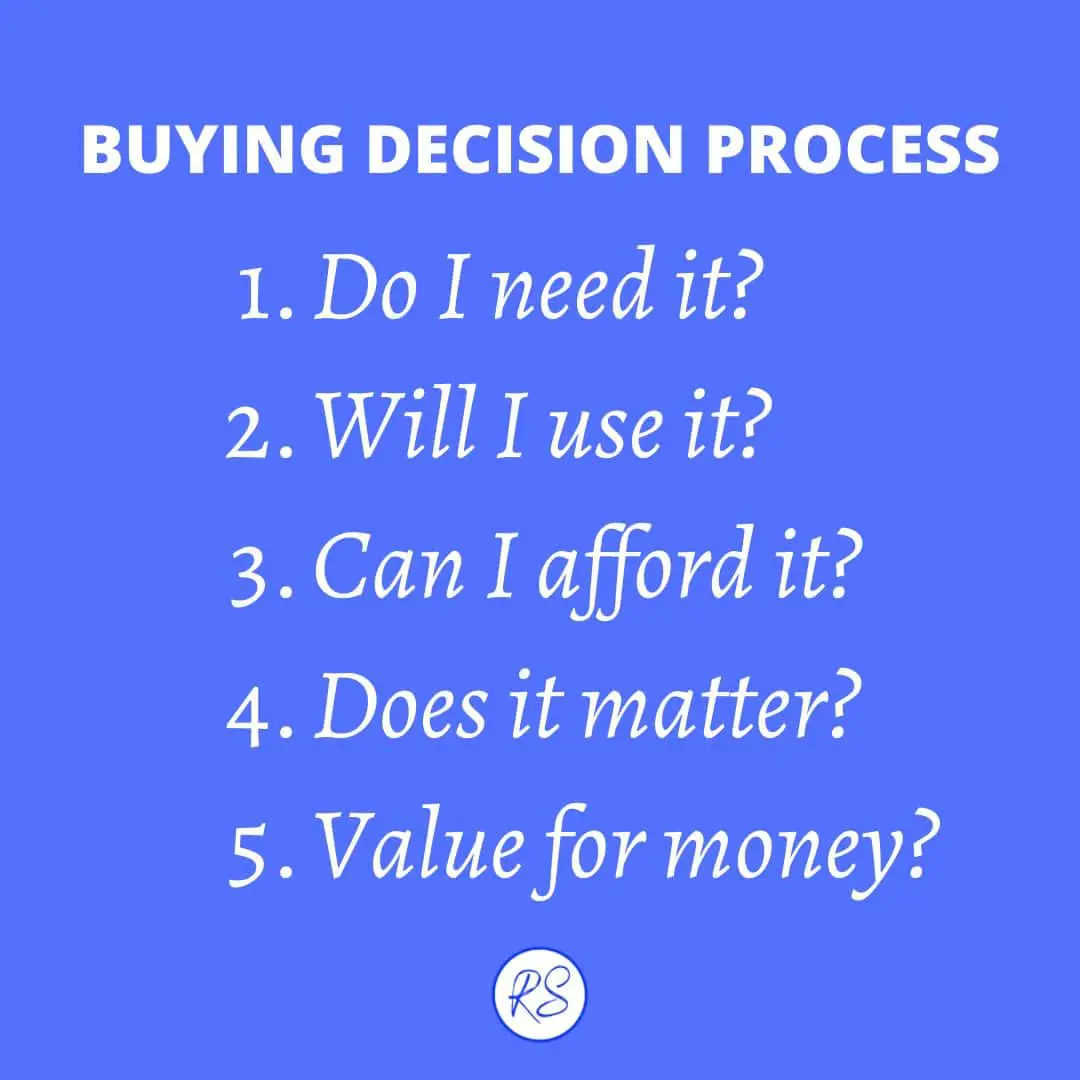
There are, in fact, five questions you should ask yourself before making any purchase, as follows:

  1. Do I need it? Honestly?
  2. Will I use it? Honestly?
  3. Can I afford it? Honestly?
  4. If I didn’t have it, would it matter?
  5. Does it represent value for money?

If you answer ‘No’ to the first four questions, the fifth question is irrelevant.

A negative on all or even most of the first four questions means don’t buy the item. Simple!

And even if you do think you need it, never buy anything if you do not have the money to pay for the item right now. Never, ever incur debt for a discretionary purchase.

It’s better to do without than to run up debt on a credit card to pay for discretionary purchases.

The compounding effect of high credit card interest rates can quickly turn a small debt into a large one.

The ‘value for money’ question is only relevant when you can answer every other question in the affirmative.

Nevertheless, you should never buy something that’s not also good value for money.

That is, you should never overpay for anything.

Overpaying means the price is inconsistent with the value on offer.

Let the answers to the questions guide you:

To ensure your buying decision process is sound, you must always ask these questions.

Let them be your purchasing guide, and you’ll be in a better position to start saving money and watch it grow.

Once it starts growing, you’ll be on your way to building your own personal wealth.

Make Money

Please share this post with your friends:

Did you find this article interesting and useful?

If so, then please share it on social media with your friends.

When you share, everyone wins.

So please share it now. If you do, I will be forever grateful, and you’ll be helping a keen blogger reach a wider audience.

Thank you.


Other articles that might appeal to you:

How to turn your yearly income into your monthly income

Would you like to learn how to turn your yearly income into your monthly income?

Perhaps you are one of those people who feel you should be earning more than you do.

To have enough money to enjoy the lifestyle you’d love?

You’d like a higher income, but you’re unsure how to achieve it.

Perhaps you feel that big money never flows to people like you.

A natural assumption, possibly, but it’s wrong.

With the right approach, you too can have significantly more money than you have now. Yes, you can become truly wealthy.

The question is, where do you begin?

You can start by understanding the Law of Compensation. In the video included here, the self-help guru Bob Proctor explains that income is earned according to the Law of Compensation.

Make Money

The Law of Compensation:

Bob explains that the Law of Compensation states that the amount of money you earn will always be in exact ratio to the following three points, namely:

  1. The NEED for what you do.
  2. Your ABILITY to do it.
  3. The DIFFICULTY there would be in REPLACING YOU.

Now you have no control over points 1 and 3, so you must concentrate on point number 2.

You must constantly hone your skills and become a master of whatever you do.

That said, becoming a master of what you do is only part of the solution.

To earn more, you must decide on your strategy for earning money. In the video, Bob Proctor explains that there are only three strategies for earning money.

The Strategies for Earning Money:

So what are the three income-earning strategies? Bob Proctor describes these as M1, M2, and M3. In more detail, that means:

M1: Trading your time for money:

Essentially, this is paid employment, and it is the way that 96% of people earn an income.

The problem is that, unless you’re a Wall Street banker, you’re unlikely to get rich this way. It probably explains why you’re not rich right now.

M2: Invest Money to Earn Money:

Assuming you’re working for the man as a salaried employee, you can start saving, and gradually, as your savings grow, you can invest your money in stocks, bonds, and property, and over time, your investments will start generating an income of their own.

That’s great, but you need to know what you’re doing. If you have nothing now, it will take some time before you can start generating anything approaching a useful extra income.

Of course, if you have a large sum of money available right now, then this might be a solution; however, for most people, it’s not feasible, which is why only around 3% of people make an income this way.

M3: Multiply your time with multiple sources of income:

Establishing multiple income streams is a great way to start generating substantial income.

Even fewer people make an income this way, around 1%, but that has more to do with the fact that most people fail to recognize its potential.

Now, let me make one thing clear: having multiple income streams does not mean working multiple jobs.

It means having income streams that will earn money for you even while you’re sleeping. And as the legendary investor Warren Buffett once said, “If you don’t find a way to make money while you sleep, you will work until you die.

M3 Income Strategy:

M3 is the income strategy that will help you earn far more than you earn now. Certainly, it will if you do it right.

Bob Proctor offers the example of Network Marketing (also known as Multi-Level Marketing), whereby not only do you sell products, but you also create a network of sellers, which means that when they sell, you receive a portion of the commission generated from those sales.

The best network marketers have made a significant amount of money this way, but it’s not the only solution to generate multiple streams of income.

The internet now offers multiple ways to get rich online.

For instance, you can use Amazon as a marketplace and sell products with fulfilment (delivery to the customer) handled by Amazon.

You can also generate commissions through affiliate marketing with Amazon, as well as other platforms like ClickBank and Commission Junction (CJ). These can be great ways to make money whilst you sleep.

Blogging and Vlogging are also other ways to produce income streams.

There are numerous ways for the ambitious and determined. It’s never been easier for people prepared to put in the effort.

So listen to what Bob Proctor has to say and be inspired to take action now.

The Game of Money-Making:

Further Reading:

In the video, Bob Proctor references Think and Grow Rich by Napoleon Hill.

Think and Grow Rich is a classic book in the field of financial education. It’s an essential reference book for anyone serious about achieving wealth.

Originally written in the 1930s, it remains popular and relevant today.

It’s still around for a reason. It’s exceptional and worth adding to your reference library. It’s a ‘must-read’ if you want to master the game of money-making. I have my copy, and you’d be wise to purchase yours.

Bob Proctor has also produced some excellent self-help books, which are available on Amazon.

Make Money

Please share this post with your friends:

If this article on how to turn your yearly income into your monthly income proved interesting, your friends might like it too.

If so, please share it on social media with your friends. When you share, everyone wins.

So, please share it now. If you do, I will be ever so grateful, and you’ll be helping a keen blogger reach a wider audience.

Thank you.

Other articles you might find interesting:

Work and Money: Which is more important?

Today, let’s discuss work and money.

How often are we tempted to do something just for the money?

Indeed, I’ve done many things for money alone, and perhaps you have too, dear reader.

In my experience, it has always proved to be a mistake because no amount of money can compensate you for the drudgery of doing something you hate.

And more importantly, if you hate what you’re doing, you’re unlikely to do it very well, are you? It’s hard to feel motivated to do something you hate, surely?

WORK and MONEY
Make Money

Work and money:

My message today is simple. If you don’t enjoy what you’re doing, you won’t do it well. And if you don’t do it well, eventually you’ll come unstuck. And so it’s all going to end in tears, very probably.

Conversely, if you genuinely enjoy what you’re doing, it’ll hardly seem like work at all, and you’ll be motivated to do it well and produce the best results possible.

Do it well, and people will notice. Once they start to notice, your career will begin to move forward and upward. Every hiring manager wants someone with a track record for delivering exceptional results.

So never do anything for money alone. Money is nice to have, of course, and none of us can get by these days without it. However, life’s too short to spend your time doing something you hate.

Find a job that’s right for you first, and then work hard to master your trade. Improve at it, become more valuable, and then maximise your income.

When you’re producing exceptional results, never forget to ensure you’re getting paid what you’re worth.

It should never be about the money, but that doesn’t mean you should ignore your value and undervalue yourself. It’s about work and the value you can add first, and then it’s about ensuring you’re suitably rewarded for the value you deliver.

Be a dedicated professional, of course, but don’t be a mug. Just because it’s not about the money doesn’t mean you should ignore the money.

You may not be driven by money, but it’s fair to accept the reward for your efforts.

Please share this post with your friends:

If you found this article inspiring, please share it on social media with your friends.

When you share, everyone wins.

So, please share it now. If you can do that for me, I’ll be ever so grateful, and you’ll be helping a keen blogger reach a wider audience.

Thank you.

Make Money

Other articles you might find interesting:

3 ways for getting rich

Today, I am exploring the idea of getting rich.

You should never take money too seriously, dear reader, but, equally, you should never underestimate the importance of money either. Let’s face it, in the modern world, money is as essential to sustaining life as oxygen. That’s a fact, whether we like it or not. So getting rich is a worthy topic for discussion.

By getting rich, I mean achieving financial freedom. I think that should be everyone’s goal, if only so that they can enjoy their old age. In my opinion, there’s nothing wrong with getting rich, provided money does not become your obsession. That is, you should have money in your head but not in your heart.

Now getting rich is easier said than done, of course. It requires effort on your part and a lot of determination, too.

Nevertheless, getting rich is also easier than it might first appear to be.

So today I offer you three ways for getting rich that are available to anyone and everyone, and they will all help you to achieve financial freedom.

Make Money

Getting Rich:

1. Solve problems for people:

Working for someone else may make you a living, but having your own business can make you a fortune. The only way most people can become seriously rich is by setting up a business of their own. It can be done, and people do, very successfully, and you can do it too.

Essentially, business is all about solving problems for people in exchange for money.

Businesses create products that solve problems for customers. The customer buys the product, and the business makes money. You need to ensure that your revenues exceed your overheads, but in essence, business is that simple.

If you want to make money in business, look for problems to be solved, and there you’ll find commercial opportunities.

One person’s problem is another person’s business opportunity.

However, do make sure that every product you offer solves a problem for your customers.

That means understanding the needs and wants of your target customers and always asking the question, “What problem will this product solve for my customers?

2. Risk leads to reward:

If you want to make serious money, you cannot avoid an element of risk. That’s a fact of business life.

Entrepreneurs have to be risk-takers by definition.

However, that doesn’t mean you take crazy risks. It means taking calculated risks by doing your homework, proper planning and market research, and using your business skills to weigh up the pros and cons of every opportunity.

Risk is simply the probability of you getting an outcome you don’t want.

However, it’s a fact that risk and reward go hand in hand. The greater the reward on offer, the greater the risk you must potentially take to achieve it.

Your attitude to risk is important here.

If a given risk makes you very uncomfortable, then it’s probably not worth taking. It will just lead to too much stress for you. Some people can live with huge risks, while others cannot cope with that much pressure.

Either way, it doesn’t matter. If you can’t cope with significant risks, then avoid them. Just look for something with lower risk and with which you can manage. Even small risks can lead to great riches.

Remember, we all need a mix of certainty and uncertainty in our lives. Business requires you to live with the latter, at least to some degree.

3. The magic of compounding:

Once you’ve made some money, you must put it to work for you if getting rich is your aim.

And putting money to work is all about taking advantage of the magic of compounding.

Compound interest can have a powerful effect on your money.

For instance, if you invest $1,000 at 2% for 10 years with annual interest reinvested, it will be worth $1,219 at maturity.

However, if you invest the same $1,000 over the same period at 10%, then you will earn $2,594, assuming annual interest is reinvested. That’s over a 100% difference over the 10-year period.

Over 20 years at 10%, your $1,000 would have turned into $6,727, assuming annual interest had been reinvested.

So remember, the interest rate and the longevity of your investment both matter if you’re trying to build a capital sum.

So if getting rich is your aim, then start by investing as early as you can, be disciplined, and make regular contributions to build that nest egg.

Further Reading:

A single blog post can only scratch the surface of all you need to know about money.

So if you’re wise, you’ll buy some books on the subject to get your financial education moving in the right direction.

Here are some books I can personally recommend, all of which I own copies of:

This is essential reading for anyone seeking a financial education, for the following reasons:

Timeless Wisdom – Over 100 million copies sold. If it worked for Carnegie, Ford, and thousands more, it could work for you, too.

Proven Success Formula – Based on 20 years of research, this book translates the habits of wealthy people into actionable steps anyone can follow.

Attract Opportunity – Hill was teaching the “Law of Attraction” before it was a trend, and he shows how to align your goals with actionable plans.

Master the Power of Thought – Learn how your mindset shapes your success. Hill reveals how belief and persistence turn ideas into reality.

Overcome Self-Doubt – Discover how to eliminate fear, hesitation, and excuses—replacing them with confidence and determination.

Think and Grow Rich is a classic of the genre. It was written in the 1930s, but it remains popular because it offers a helpful framework for achieving success and wealth by cultivating a positive mindset and developing specific principles. It’s that simple, and it’s worth adding to your reference library.

This book is essential reading because of its simplicity. Compelling reasons to read this book include:

Timeless Money Rules – Ancient wisdom meets modern wealth-building. These principles worked 5,000 years ago—and they still work today.

Simple, No-Nonsense Advice – No complicated strategies. Just clear, actionable lessons like “Pay yourself first” and “Make your gold work for you.”

Escape the Paycheck Trap – Learn how to save, invest, and grow wealth—even if you’re starting with little.

Avoid Costly Mistakes – This book teaches you how to protect your money, dodge debt, and build lasting prosperity.

Short & Powerful – Each lesson is a quick, engaging story. You’ll finish it in a day, but the lessons will be with you for life.

If you’re looking to achieve financial freedom, start with the book that’s helped millions get there. It’s inspiring but straightforward. You can read this book in a few hours, but it will provide you with a series of powerful lessons for acquiring money, keeping money, and making money. Again, it’s well worth adding to your reference library.

This is a book that has sold by the shedload, and continues to do so, and it’s essential reading for the following reasons:

Shift Your Money Mindset – Learn why the rich don’t work for money—they make money work for them.

Escape the Rat Race – Most people trade time for money. This book shows you how to build assets that generate income without grinding 9-to-5.

Debunk Money Myths – Schools don’t teach financial literacy. Kiyosaki reveals the truths about wealth that your “Poor Dad” never knew.

Take Control of Your Future – Stop fearing bills and start investing. Real estate, stocks, and businesses aren’t just for the rich; they’re for the educated.

Simple & Motivational – No complex jargon, just straight talk that pushes you to think and act differently about money.

If you’re tired of having too much month left at the end of the money, this book is your wake-up call. Please read it. Apply it. Change your life.

Rich Dad Poor Dad is an excellent starting point for anyone seeking to improve their financial knowledge and enhance their financial future. It is a modern take on the books above, but it has also become a classic and is worth every penny of the cover price.

There is a commonly held view that the stock market is just a casino and buying and selling stocks is a form of gambling. This isn’t true.

Investing in a stock is the purchase of an asset that will provide you with a financial return through dividends and capital appreciation over time.

The trick is to know what you’re doing and to invest wisely.

And if you do know what you’re doing, the financial gains can be substantial. For instance, if you’d invested $1,000 in Google in 2004, your shares in Alphabet, the search giant’s parent, would be worth somewhere around $70,000 today. That’s a very healthy return on investment.  

The question is, how do you ensure you know what you’re doing? Well, a good start would be to read One Hour Investor by Russell Ellroy. From it you will learn:

Investing Made Simple – No confusing jargon or complex theories. Just a clear, step-by-step guide to start investing, even if you know nothing.

Fast & Efficient – Designed for busy people. Learn the essentials in just one hour and start growing your money immediately.

Avoid Costly Mistakes – Get the dos and don’ts of stock market investing from the start, so you don’t lose money on beginner errors.

Build Confidence – Overcome fear and analysis paralysis with straightforward strategies anyone can follow.

Start Small, Grow Big – You don’t need a fortune to begin. Learn how to invest with little money and compound your wealth over time.

If you want to learn about stocks, bonds, mutual funds, and much more, this is the book for you. Written in a very accessible style and aimed at the absolute beginner.

If you want to take control of your financial future without wasting time, this book is a perfect first step. Read it today, and you’ll profit tomorrow.

I have all of these books in my library, and I frequently dip in and out of them. They will inspire you, I am sure, and I recommend that you purchase copies.

Make Money

Please share this post:

Did you find this article interesting and valuable? If so, then please share it on social media with your friends.

When you share, everyone wins.

So go on, please share it now. If you do, I will be ever so grateful, and you’ll be helping a keen blogger reach a wider audience.

I appreciate your support. Thank you.

Other articles you might find interesting:

25 inspirational stories of people going from rags to riches

Inspirational stories can be so uplifting. Their message always says, “If other people can be successful, then you can too.

Did you have a tough start in life?

Then perhaps you feel that your difficult past will prevent you from enjoying a successful future.

Well, let me tell you, a tough past doesn’t mean you’re doomed to a tough future.

A friend of mine had a very difficult start in life, and yet he’s now a millionaire. People do succeed, and so can you.

The past is the past, of course, and it can’t be changed. It serves only as a series of lessons to be learned. Remember, the past was simply part of your education. It was not a life sentence.

The future is different. The future has yet to be written, and the good news is, you’ve got the pen.

You can create any future you want, as long as you’re determined, focused, and prepared to put in plenty of hard work. You won’t get anywhere without those ingredients, I’m afraid.

Nevertheless, in the future there will be a constant stream of opportunities to be seized, just waiting for the fleet-footed and enterprising to grab and exploit them. One person’s problem is another person’s opportunity to provide a solution for a profit.

Success can be yours if you’re prepared to make the effort and take a few calculated risks.

Don’t just accept my word for it; look around for people who’ve done it.

There are plenty of inspirational stories if you’ll just look for them. Today I offer you a video with 25 inspirational stories. It’s well worth a few minutes of your time.

25 Inspirational Stories:

In the video included here, there are 25 excellent examples of people who had a tough start in life but went on to enjoy considerable financial success.

These are all inspirational stories of people going from rags to riches. And if they can do it, why not you?

And remember this: you’re never too old.

Colonel Sanders started KFC at the grand old age of 65.

And Ray Kroc began building the business empire we now know as McDonald’s at 52.

Believe you can and you will.

Please share this post on social media:

Did you find this post and the video interesting? If so, then please share it on social media with your friends.

When you share, everyone wins.

So go on, please share this blog post now. If you do, I will be ever so grateful, and you’ll be helping a keen blogger reach a wider audience.

Thank you for your support.