Daily Habits of Successful People

If success is your aim, can you learn from the daily habits of successful people?

Certainly, I believe quite strongly that we are what we do daily.

Anything you achieve or don’t achieve is brought about by the habits you develop over time.

Everything you do is a result of your habits, good or bad. So surely it makes sense to develop and maintain good habits and make them your master?

The power of repetition:

Habits, good or bad, are formed through repetition.

Good habits can be hard to form, but they’re easy to live with. Whereas bad habits, whilst easy to form, tend to be very hard to live with. Our lives can become a battle of good habits versus bad habits. Don’t let the bad habits win.

Good habits can be learned, and bad habits can be replaced by good habits. Yes, it requires self-discipline on your part, dear reader, but it can be done, and people do.

Decide on the habits you want to develop and focus on achieving them one at a time.

Start with one good habit:

Start with one good habit you’d like to form and then force yourself to repeat the necessary actions daily.

After around three weeks, that habit will be formed, and it will just become part of your routine. You’ll start to repeat it with little or no thought. Essentially, you’ll do it on autopilot.

If you have a bad habit you wish to replace with a good habit, then each time you find yourself about to perform the actions of the bad habit, stop yourself and perform the actions of the good habit instead. Again, after around three weeks, the good habit will be programmed into your brain.


Make Money

Self-discipline is key:

Successful people are driven to develop good habits. Self-discipline is the key ingredient for good habits to form and for replacing bad habits.

Successful people also establish the habit of goal setting on a daily basis.

You cannot hit a target unless you can see that target. Setting a goal is the first step in achieving that goal. Successful people are results-oriented.

Successful people are also people-oriented.

The power of helping others:

You get what you want in life by helping other people get what they want.

Every product is a solution to a problem. Even if your goal is to sing or dance, to succeed you must always recognise that you perform to and for people.

They have a need to be entertained and your aim is to fulfil that need. To solve this particular problem for them if you like.

In dealing with people you must be honest and show integrity if you are to win the respect of others.

So honesty is a good habit to develop. Dishonesty and cheating will catch up with you and will be a permanent stain on your reputation. You don’t need that now, do you?

Look after your health:

And above all, you must look after your health. You have one body and one mind and they must last you a lifetime.

So develop the habit of taking good care of both.

To reinforce the message of the importance of repetition and routine I‘ve included this excellent video from Brian Tracy.

Brian is always a source of great advice for anyone seeking success and aiming to create a successful life for themselves and certainly, he’s one of my main sources of constant inspiration.

The video is short but well worth your time and I recommend you watch it now.

Habits of successful people:

Further Reading:

Regular readers will know that I am keen on building a personal reference library of books and audiobooks, which I use to inspire and motivate me and to help me achieve my goals. And I would encourage you to do the same, dear reader.

In the video, Brian Tracy refers to his book Million Dollar Habits: Proven Power Practices to Double and Triple Your Income. This is an excellent book and would be a good addition to your library. You can take a look at the print and Kindle editions if you click on the link in this paragraph.

However, I must be honest and tell you that, actually, I decided to purchase Million Dollar Habits: Proven Power Practices to Double and Triple Your Income (AudioBook). Personally, I find the audiobooks really useful because I can listen to them whilst I’m driving, which means I’m making better use of what would otherwise be dead time. If you’d like to take a look at the audio version of the book, then, once again, just click on the link in this paragraph.

If you’re looking for useful articles on this subject that are free to read, then you might want to take a look at The Habits of Highly Successful People, which has been published on the Porch website. This is an interesting article and is worth a few minutes of your time.

Phil Sutton

Please share this post with your friends:

Did you find this article interesting and useful dear reader?

If so, then please share it on social media with your friends. When you share, everyone wins.

So please share it now. If you do I’ll be ever so grateful and you’ll be helping a keen blogger reach a wider audience.

Thank you.

How is success achieved? Could this be the secret?

How is success achieved? Certainly many desire it, but few achieve it. Why is that, do you think, dear reader?

Could it be all about your mindset? Can your thinking have an impact on whether you succeed or not?

In the embedded video, Carrie Green suggests that your mindset matters.

Make Money

Programming your mind for success:

This is an inspirational talk on success by Ms Carrie Green, who gave it at TEDxManchester.

Her underlying message is that success is never achieved by accident.

I’d not heard Carrie Green speak before I stumbled on this video, but I must say I’m very impressed.

If you can spare a few minutes, then this video is well worth a little piece of your time. I’m confident that you won’t be disappointed. Recommended.

Phil Sutton

Please share this post with your friends:

Did you find this article interesting and useful, dear reader?

If so, then please share it on social media with your friends. When you share, everyone wins.

So please share it now. If you do, I’ll be ever so grateful, and you’ll be helping a keen blogger reach a wider audience.

Thank you.

Go Explore London

30 thought-provoking quotes about the way it is today

Today, I am exploring quotes about the way it is today.

If you’re looking for some thought-provoking quotes to get your mind ticking over, then here are 30 good ones for you, dear reader.

I’m confident they will get you thinking and reflecting on life and its meaning.

So, grab a coffee, take an unofficial break, and enjoy them all.

Please feel free to use some of them yourself to reinforce a point you’re trying to make. And feel free to pass them on, too.

Make Money

Thought-provoking quotes (1-15):

  1. Just because it’s a cliche doesn’t mean it’s not true. 
  2. No one will believe in you if you don’t believe in yourself.
  3. If your thinkin’ is stinkin’ don’t be surprised if your life is sinkin’.
  4. How people appear to be and how they are is not the same thing. 
  5. Grabbing media attention is not the same as winning hearts and minds.
  6. When you’re trying too hard to be kind, you’re probably not being kind at all.
  7. No one has a monopoly on wisdom. Most people don’t even have their fair share. 
  8. It’s nice to have qualifications, but it’s much better to have a job to which you’re well-suited.
  9. Reputations are hard won but easily lost. If you have a good one, make sure you protect it. 
  10. The rich will ensure they remain rich, however much it might be at the expense of the poor. 
  11. People don’t want to hear your opinion. They just want you to accept theirs without question.
  12. We view every political failure through the prism of that with which we vehemently disagree. 
  13. We all want our own way, all the time. That’s why it’s good for us to be denied it occasionally. 
  14. To be silent is to be irrelevant. Don’t be silent, and don’t be irrelevant. Make your voice heard.
  15. Some of the greatest bigots of the modern age are those who are quick to accuse others of bigotry.
Phil Sutton

Thought-provoking quotes (16-25):

  1. In today’s world, feelings matter more than truth. Pretence takes precedence over inconvenient truths. 
  2. Look after your own interests. No one cares about what’s good for you; they only care about what’s good for them. 
  3. Some people are so convinced by the virtue of their own opinion that they can’t even begin to imagine that they may be wrong. 
  4. The issue is not the silent majority, it’s the silenced majority. People are being bullied into remaining silent for fear of being cancelled.
  5. It’s a mistake to assume that the government is your friend. It’s not. Governments act in their interest, not yours. Question everything. 
  6. Never buy discretionary items with debt. Unsecured debt is very expensive and can easily lead to you being locked into a debt spiral.
  7. Mass immigration without assimilation will lead to a breakdown in social cohesion, and that would be in no one’s interests. Assimilation matters.
  8. The western world is in the grip of a collective madness the like of which we’ve never seen. If wiser heads don’t prevail, we’re all in serious trouble.
  9. If not you, then who? If you don’t make your voice heard, who will? To be silent is to be irrelevant. We don’t have to accept that which is unacceptable.
  10. Judge not through the prism of your prejudices, but look closer to the real person lying beyond your first impression. People are deeper than they first appear to be.
Go Explore London

Thought-provoking quotes (26-30):

  1. It’s never about what they say it’s about; it’s always about something else. The question is, what? Always look for the underlying motivation. Never accept anything at face value. 
  2. Just because you’re asked a question doesn’t mean you’re obliged to provide an answer. Respond politely, of course, but you decide whether it’s in your interests to provide an answer. 
  3. You don’t have to win every argument. You can always walk away and just enjoy a little peace of mind. Your mental health is more important than wasting your energy arguing with people who will never see your point of view anyway.
  4. You’ll be judged not by the qualifications you’ve gained but by the difference you’ve made to the lives of others. It’s nice to have a few qualifications, but much better to know you’ve made a difference. That’s where your real focus should be.
  5. When a media personality or politician apologises for some past transgression, the question to ask is, “Why now?” If it’s because the story was about to break anyway, then you know the apology is more about damage limitation than any real desire to make amends. 
Saily eSIM

Please share these quotes:

If you found these quotes inspiring and interesting, then please share this post on social media with your friends. When you share, everyone wins.

So go on, please share this post now. If you do, I’ll be ever so grateful, and you’ll be helping a keen blogger reach a wider audience.

Thank you for your support.

Articles you might enjoy:

Set SMART Goals: A Blueprint for Success

Setting goals is key to success, but not all goals are made equal.

This approach to goal-setting gives you a clear roadmap and helps you stay focused on what matters most.

SMART goals work for both personal and professional growth. They push you to think deeply about what you want to achieve and how you’ll get there. By breaking down big dreams into smaller, doable steps, SMART goals make your aims feel less daunting and more within reach.

Using the SMART method can boost your chances of meeting your goals. It helps you track your progress, stay motivated, and make adjustments as needed. Whether you’re aiming to improve your skills at work or make positive changes in your life, SMART goals can guide you to success.

Key Takeaways

  • SMART goals provide a clear, structured way to set and achieve objectives
  • The SMART method applies to both personal and professional goal-setting
  • Using SMART goals increases the likelihood of reaching your targets
Make Money

Understanding SMART Goals

SMART goals provide a clear framework for setting and achieving objectives. They help people and businesses create plans that are easy to follow and measure.

Definition and Origin

SMART is an acronym that stands for Specific, Measurable, Achievable, Realistic, and Timely. This goal-setting method helps create clear and actionable plans.

The SMART criteria were first introduced in the 1980s. Management experts developed this approach to improve goal-setting in organizations.

SMART goals are:

  • Specific: Clearly defined and focused
  • Measurable: Progress can be tracked
  • Achievable: Within reach given available resources
  • Realistic: Aligned with broader objectives
  • Timely: Have a set deadline or timeframe

Benefits of SMART Goals

SMART goals offer several advantages for individuals and organizations. They provide structure and guidance, making it easier to turn ideas into action.

One key benefit is improved focus. SMART goals help people concentrate on what’s most important. This leads to better use of time and resources.

Another advantage is increased motivation. Clear, achievable goals give people something concrete to work towards. This can boost confidence and drive.

SMART goals also make it easier to track progress. The measurable aspect allows for regular check-ins and adjustments as needed.

Lastly, SMART goals improve communication. They provide a common language for discussing objectives and expectations within teams or organizations.

Specific

Making goals specific is key to success. Clear and detailed objectives help focus efforts and increase the chances of achievement. Let’s explore how to define clear goals and why being specific matters.

Defining Clear Objectives

SMART goals start with being specific. This means stating exactly what you want to achieve. Instead of saying “I want to get fit,” a specific goal would be “I want to run a 5K race in under 30 minutes.”

Specific goals answer these questions:

  • What do I want to accomplish?
  • Why is this goal important?
  • Who is involved?
  • Where will it take place?
  • Which resources or limits are involved?

By answering these questions, you create a clear picture of your goal. This clarity helps you stay motivated and on track.

Importance of Specificity

Specific goals are powerful tools for success. They remove confusion and provide a clear target to aim for. When a goal is vague, it’s hard to know if you’ve achieved it.

Specific goals also help with planning. They make it easier to break down big tasks into smaller steps. This breakdown allows for better tracking of progress.

Research shows that specific goals lead to better performance. They help people focus their efforts and persist in the face of challenges. Vague goals, on the other hand, can lead to frustration and giving up.

Measurable

Measurable goals allow you to track progress and know when you’ve achieved success. Setting clear metrics and using the right tools helps you stay on track.

Establishing Metrics for Tracking Progress

To make goals measurable, set specific numbers or percentages. For example, “increase sales by 15%” is more measurable than “boost sales.”

Use these types of metrics:

  • Quantity: Number of items sold, customers served, etc.
  • Quality: Customer satisfaction scores, error rates
  • Time: Project completion dates, response times
  • Cost: Budget targets, revenue goals

Break big goals into smaller milestones. This makes progress easier to measure along the way. For instance, if aiming to gain 1000 new customers in a year, set monthly targets of about 83 new customers.

Tools for Measurement

Many tools can help track goal progress. Choose ones that fit your goals and work style.

Digital options:

  • Spreadsheets for data entry and calculations
  • Project management software to monitor tasks and deadlines
  • Analytics platforms for website or social media metrics

Physical tools work too:

  • Wall charts or calendars to mark milestones
  • Notebooks for daily progress notes
  • Whiteboards for team goal tracking

Pick tools that make data easy to record and review. Regular check-ins help spot issues early. Daily, weekly, or monthly reviews keep goals on track.

Remember to adjust metrics if needed. As you learn more, you may find better ways to measure success.

Phil Sutton

Achievable

Setting achievable goals is crucial for success. It involves assessing your capabilities and resources realistically while still pushing yourself to grow.

Setting Realistic Standards

Realistic goals take into account your current skills and situation. Look at your past accomplishments to gauge what you can achieve. Break big goals into smaller steps.

Achievable goals are challenging but possible. They stretch your abilities without being impossible.

Consider your available time, money, and other resources. Be honest about potential obstacles.

Get input from others who know your field or situation. Their perspective can help set realistic benchmarks.

Balancing Ambition and Practicality

Ambitious goals inspire growth, but must be grounded in reality. Aim high while keeping expectations reasonable.

Start with moderately challenging targets. As you gain confidence and skills, gradually increase difficulty.

Review your goals regularly to ensure they remain achievable. Adjust if circumstances change or you encounter unexpected barriers.

Celebrate small wins along the way. This builds momentum and motivation for bigger achievements.

Learn from setbacks. Use them to refine your approach and set more accurate goals in the future.

Relevant

Goals need to matter and align with your broader objectives. The right goals push you forward and connect to your values and vision.

Aligning Goals with Values

Relevant goals match your personal or company mission. They fit with your core values and long-term plans. Think about why each goal matters to you.

Ask yourself: Does this goal help me grow? Will it make a real difference? Does it excite me?

Goals that align with your values are more motivating. You’ll work harder to reach them. They give your efforts more meaning and purpose.

Consider how each goal fits into the bigger picture of your life or work. Make sure it takes you in the direction you want to go.

Ensuring Goal Relevance in Changing Environments

Goals need to stay relevant as things change. What matters today might not matter tomorrow. Review your goals often to make sure they still fit.

Be ready to adjust goals when needed. New information or events might shift your priorities. It’s okay to change course if a goal no longer makes sense.

Keep an eye on trends in your field. Stay flexible and open to new ideas. This helps you set goals that keep you ahead of the curve.

Ask for input from others. They might see things you don’t. Fresh perspectives can help you spot new opportunities and stay relevant.

Time-Bound

SMART goals need a clear timeline for completion. Setting deadlines creates urgency and helps track progress effectively.

Defining a Timeline

Time-bound goals have specific deadlines. This helps people stay focused and motivated. When setting a timeline, consider these factors:

  • Project complexity
  • Available resources
  • Other commitments

Break larger goals into smaller milestones with their own deadlines. This makes progress easier to track.

Use a calendar or project management tool to mark important dates. Regular check-ins help ensure the goal stays on track.

Adapting to Time Constraints

Sometimes, unexpected events can affect a goal’s timeline. It’s important to be flexible and adjust when needed.

If a deadline seems unrealistic, don’t give up. Instead, try these strategies:

  • Reassess priorities
  • Seek additional resources
  • Modify the goal’s scope

Time-bound goals create a sense of urgency. This can boost productivity and motivation. However, be careful not to set overly aggressive deadlines that lead to burnout.

Regular progress reviews help identify if timelines need adjustment. This allows for timely changes to keep the goal achievable and relevant.

Go Explore London

Writing SMART Goals

Creating SMART goals helps you set clear, achievable objectives. This method breaks down goals into key components and helps avoid common mistakes.

Formulating Effective Statements

SMART goals are Specific, Measurable, Achievable, Relevant, and Time-bound. To write a SMART goal, start with a clear action verb. Make it specific by answering who, what, where, when, and why.

Include a measurable element, like numbers or percentages. This makes progress trackable. Set an achievable target that challenges you but remains realistic.

Ensure the goal is relevant to your larger objectives. Finally, add a time frame to create urgency and accountability.

Example: “Increase monthly website traffic by 25% within 3 months by publishing 2 blog posts per week and optimizing 5 existing pages for SEO.”

Common Pitfalls to Avoid

Vague language is a major pitfall in goal-setting. Avoid words like “more” or “better” without specific metrics. Don’t set unrealistic goals that lead to frustration.

Forgetting to align goals with broader objectives can waste effort. Make sure each goal supports your overall strategy.

Neglecting to set deadlines often results in procrastination. Always include a clear end date.

Avoid setting too many goals at once. Focus on a few key objectives to maintain motivation and prevent overwhelm.

Lastly, don’t ignore the importance of regular review. Schedule check-ins to assess progress and adjust goals as needed.

Implementing SMART Goals

Putting SMART goals into action requires careful planning and ongoing management. Creating detailed action plans and regularly monitoring progress are key steps to achieving success.

Action Plans and Roadmaps

Developing an action plan is crucial for turning SMART goals into reality. Break down each goal into smaller, actionable steps. These steps should be specific tasks with deadlines.

Create a timeline or roadmap showing when each task needs to be completed. This visual aid helps track progress and keeps everyone aligned.

Assign responsibilities for each task. Clear ownership ensures accountability and prevents important steps from being overlooked.

Include necessary resources in the plan. Identify what tools, skills, or support are needed to accomplish each task.

Monitoring and Adjusting Goals

Regular check-ins are essential to track progress and make adjustments as needed. Set up a schedule for reviewing goals, such as weekly or monthly meetings.

Use measurable metrics to assess advancement. Compare current results to the initial targets set in the SMART goal.

Be prepared to modify goals if circumstances change. Flexibility allows for adapting to new information or unexpected challenges.

Celebrate milestones along the way. Recognizing progress boosts motivation and maintains momentum towards the final goal.

Examples of SMART Goals

SMART goals help people achieve success in various areas of life. These goals are specific, measurable, achievable, relevant, and time-bound. Let’s look at some real-world examples.

Personal Success Stories

Jane set a SMART goal to run a marathon within 6 months. She made a detailed training plan and tracked her progress weekly.

By breaking her goal into smaller milestones, Jane stayed motivated. She gradually increased her running distance and speed.

After 6 months of hard work, Jane completed her first marathon. Her success inspired her to set new fitness goals for the future.

Tom wanted to save money for a house down payment. He set a SMART goal to save $20,000 in 2 years.

Tom created a budget and set up automatic transfers to his savings account. He also found ways to increase his income through side jobs.

By tracking his progress monthly, Tom reached his savings goal on time. This allowed him to buy his first home.

Case Studies in Different Domains

In business, a small startup set a SMART goal to increase website traffic by 50% in 3 months. They focused on creating quality content and optimizing for search engines.

The team monitored their progress weekly using analytics tools. They adjusted their strategy based on the data. After 3 months, they exceeded their goal with a 60% increase in traffic.

In education, a high school set a SMART goal to improve student reading scores by 10% in one academic year. They implemented a new reading program and provided extra support for struggling students.

Teachers tracked student progress monthly. By the end of the year, the school achieved a 12% improvement in reading scores. This success led to setting new academic goals for the following year.

Reviewing and Reflecting on SMART Goals

Taking time to review and reflect on SMART goals is key for growth. This process helps identify what worked well and where improvements can be made. It also provides insights for setting future goals.

Evaluating Goal Achievement

To evaluate SMART goal achievement, start by comparing results to the original targets. Look at the specific metrics set and assess if they were met. For example, if the goal was to increase sales revenue by 10%, check if this number was reached.

Consider these questions:

  • Was the goal completed on time?
  • Were all parts of the goal achieved?
  • What challenges came up during the process?

It’s important to be honest about both successes and setbacks. If a goal wasn’t fully met, try to pinpoint why. This info is valuable for future planning.

Learning from the SMART Goal Process

Reflecting on the goal-setting process itself can lead to better goals in the future. Think about how well each part of the SMART framework worked.

Ask:

  • Was the goal specific enough?
  • Were the metrics chosen easy to measure?
  • Did the goal push you while still being achievable?
  • Was the goal relevant to broader aims?
  • Did the timeframe make sense?

Use these insights to refine your approach. Maybe you need to set more challenging goals next time. Or perhaps you should break big goals into smaller steps.

Remember, the point is to keep improving. Each SMART goal cycle should make you better at setting and achieving goals.

Frequently Asked Questions

SMART goals help people set clear, achievable targets. They improve planning and boost success rates in various areas of life.

What are the essential components of SMART goals?

SMART stands for Specific, Measurable, Achievable, Relevant, and Time-bound. These five aspects help focus efforts and improve goal-setting.

Specific goals clearly define what needs to be done. Measurable goals allow progress tracking. Achievable goals are realistic and attainable.

Relevant goals align with broader objectives. Time-bound goals have deadlines for completion.

How can one effectively apply the SMART framework in goal-setting for students?

Students can use SMART goals to improve their academic performance. They should start by identifying specific areas for improvement, like raising a grade in math.

Next, they can set measurable targets, such as increasing test scores by 10%. The goal should be achievable based on current performance and available resources.

It must be relevant to their overall education plan. Finally, they should set a deadline, like the end of the semester, to create urgency.

What are some best practices for defining measurable objectives in SMART goals?

Measurable objectives use numbers and data to track progress. One best practice is to choose clear metrics that quantify progress.

For example, “increase sales by 15%” is better than “boost sales.” Another tip is to use existing data as a baseline for improvement.

Setting milestones along the way helps monitor advancement. Regular check-ins ensure the goal stays on track.

How does setting SMART goals improve business planning and outcomes?

SMART goals enhance business planning by providing clear direction. They help companies focus resources on specific objectives.

These goals make it easier to track progress and adjust strategies as needed. Employees understand their roles better when goals are clearly defined.

SMART goals also improve accountability. Teams can celebrate achievements when they reach measurable targets.

Can you provide a clear example of a SMART goal for personal development?

A SMART personal development goal could be: “Read 12 non-fiction books in the next 12 months to expand knowledge in my field.”

This goal is specific (12 books) and measurable (one per month). It’s achievable with consistent effort and relevant to career growth.

The time-bound aspect (12 months) creates a sense of urgency and helps track progress.

What techniques can be used to ensure goals align with the SMART criteria in a work environment?

One technique is to use goal-setting worksheets that prompt employees to address each SMART criterion.

Another approach is to have team discussions to refine goals collectively. This ensures goals are realistic and align with company objectives.

Regular goal reviews help maintain SMART alignment. Adjusting goals as circumstances change keeps them relevant and achievable.

Please share this post with your friends:

Did you find this article interesting and useful?

If so, then please share it on social media with your friends. When you share, everyone wins.

So go on, please share it right now. If you do, I will be ever so grateful, and you’ll be helping a keen blogger reach a wider audience.

Thank you for your support.

10 steps for making new year’s resolutions

If you’re wondering about steps for making New Year’s resolutions, dear reader, this article is for you.

As a new year approaches, it’s natural to think about the year ahead and how it might be appropriate to make some resolutions to be improved versions of ourselves.

Perhaps we feel it’s time to reinvent ourselves. Maybe we recognise that we’d be better off if we could get rid of some bad habits or possibly develop a few good habits. Lose a little weight, perhaps? Then again, maybe we think it’s time to start our own business with the goal of becoming financially independent.

Whatever it is we have in mind, the new year is a new beginning, so we often see it as a vehicle for change. We think it will provide us with the motivation to make changes in our lives. However, rarely does it work out that way successfully. Certainly not for most people, in my experience.

All too frequently, we promise ourselves that we’ll do this or that, but as January progresses, we forget we’ve even made a New Year’s resolution. And that doesn’t really help us at all, does it?

So, if you’re thinking about making some New Year’s resolutions, dear reader, make sure you don’t set yourself up for failure.

Successful change is achieved in small steps, not giant leaps.

If you’re going to make some resolutions, make sure they’re achievable. Make resolutions that are hard to keep, and they won’t be kept. Simple!

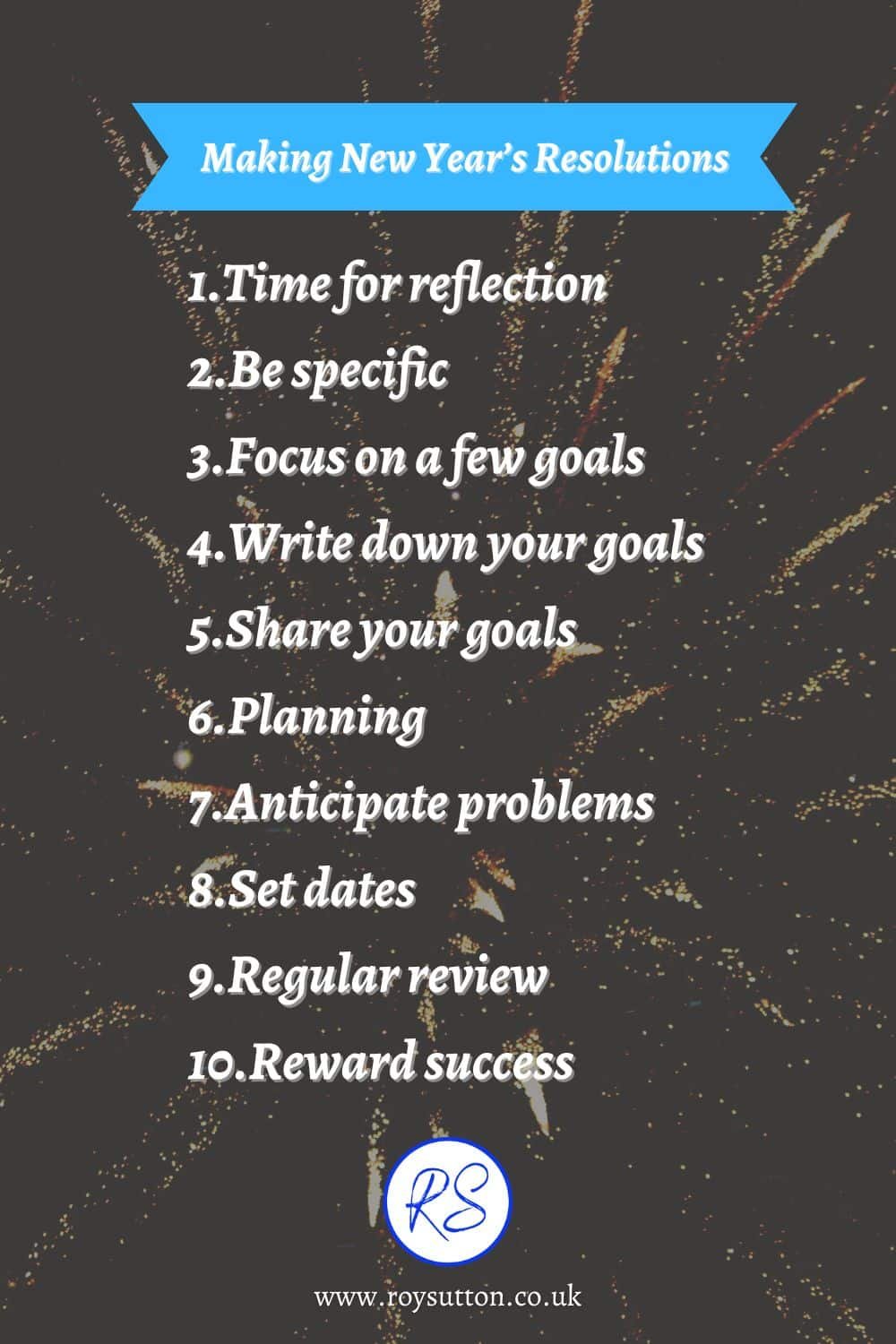
Here are 10 steps for making New Year’s resolutions you can successfully stick to for the long term:

Steps for making New Year's resolutions

Steps for making New Year’s resolutions:

1. Time for reflection:

The first step is to spend some time thinking about where you are in life and where you’d like to be.

What have you accomplished so far, and what would you like to accomplish in the future?

Where have you struggled, and why? Perhaps your skillset needs improving, or maybe you have some really bad habits that you should eliminate.

Spending some time on reflection should help you identify areas of your life that you want to focus on improving in the new year.

However, let me stress once again, think in terms of small steps rather than giant leaps.

2. Be specific:

If goals are to be achievable, then they need to be specific.

Rather than say, I want to lose weight. It’s much better to say, My goal is to lose 16 pounds by the 1st of March.

With that goal, you’ll know you must lose two pounds every week if you’re to achieve your target.

Then you can start focusing on related issues like diet, calorie count, exercise and so on.

3. Focus on a few goals:

You’re not going to achieve 20 goals in the new year. Most of them will get lost very quickly.

Decide on one, two, or possibly three things you’d like to achieve, and then prioritise them.

4. Write down your goals:

You’ll have a much greater chance of success if you commit your goals to paper.

Psychologically, it will have an impact on you if you write them down. It will seem like a true commitment, and it will drive your unconscious mind to think about what needs to be done.

5. Share your goals with someone:

Sharing your goals with a friend will again reinforce your psychological commitment to those goals.

This will help you stay motivated, and it means that you make yourself accountable as you’re working towards achieving your goals.

Let’s face it, no one wants friends or family members to know that we failed. So, if they know you’re committed to a goal, you’ll have no choice but to make sure that you achieve it.

6. Planning:

For each of your goals, you must plan accordingly.

Break each goal down into its constituent parts and come up with a plan as to how you will achieve them.

Really, this just means breaking your goals down into smaller, actionable steps and then creating a timeline for completing each step.

7. Anticipate problems:

Reaching goals is never easy. There will always be problems along the way. That’s just life.

So, make a list of the potential problems that might occur at certain times of the day, in given situations, or with certain people as you work towards achieving your goals.

Once you’ve identified the potential problems, you can then work out ways that will help you deal with them as and when they occur. In short, be prepared.

8. Set dates:

This is all about being specific again, and it fits into the planning process.

When will you get started?

When will you achieve your goal? By what date, specifically?

Be realistic, but challenge yourself too.

9. Regular review:

Right, you’ve set goals, you’ve got a plan in place, and you’ve set dates for starting and completion.

The next step is to set regular intervals to review progress.

This might be weekly, monthly, and/or quarterly. Whatever seems appropriate, depending on the goal.

As you review progress, you’ll be able to identify whether small adjustments need to be made to your plan to achieve your goal on time. 

Obviously, you’ll need to be flexible and willing to adjust your goals and plan as required.

10. Reward success:

To achieve your goal, you’ll need to be very disciplined, of course, but it also helps if there’s a potential reward at the end of the process.

So, promise yourself a suitable reward if you achieve your goal.

Success deserves to be rewarded.

Make Money

Concluding remarks:

We’ve all made resolutions over the years that have come to nothing.

It’s easy to say what we plan to do, but it’s much harder to do it and achieve our end goal.

However, just because you’ve failed with resolutions in the past doesn’t mean you’re doomed to fail in the future.

Set your resolutions carefully, approach them methodically, and don’t give up until you get to where you want to be.

It can be done, and people do. So can you!

Now that you know how to make a New Year’s resolution, you’re one step closer to achieving your goal.

Remember, small steps and not giant leaps.

Good luck!

Phil Sutton

Please share this post with your friends:

If you found this article useful, then please share it on social media with your friends.

When you share, everyone wins.

Please share it now, and I’ll be ever so grateful.

You’ll be helping a keen blogger reach a wider audience.

Thank you for your support, dear reader.

Go Explore London

Other articles you might also find interesting:

What makes a great idea and why you should keep a journal

What makes a great idea? Now, that’s an interesting question, in my opinion.

How is it that one idea can be successful and another idea less so?

Why has the iPhone been so successful, yet once-popular smartphones like the Blackberry have disappeared?

How do you know when one of your ideas might make a big difference?

The importance of timing

A key ingredient for a great idea is timing. Ideas are a dime a dozen. The trick is to know when one of your inspired thoughts is right for its time and, therefore, how hard to push it.

If you’re too far ahead of other people’s thinking, the inspired thought you believed was a great idea will only be ignored because it won’t resonate with people.

If you’re too far behind, then it will be ignored because they’ve seen it all before, or something else is already doing it better.

However, if you can hit that sweet spot between the two extremes, then you can generate value from your idea because it will solve a problem or capture the imagination of the people who are ready for it.

An idea whose time has come is a truly great idea. Though coming up with one is not so easy, of course.

Make Money

Good ideas are valuable

Great ideas are rare, so they become very valuable. And that value is why it’s worthwhile to constantly seek out great ideas.

Should you decide the world is not quite ready for your inspired thinking, don’t worry. The world not being ready now doesn’t mean the world will never be ready.

Keep a journal and make a note of all those flashes of inspiration. And add your journals to your library. Never throw your journals away. Go through them occasionally and see what ideas you’ve had for which the time might now be right.

Keep a journal

The real message today is:

Your journals could be a source of pure gold in the future, so make sure you buy quality notebooks that you can add to your library as you fill them with your thoughts and inspiration.

By keeping journals, you’re creating value. Value starts with a good-quality notebook, so it’s worth investing in quality.

And never, ever dismiss your ideas. They may not work today, but one day they may make you a fortune.

Phil Sutton

Please share this post with your friends:

If you found this article useful, then please share it on social media with your friends. When you share, everyone wins.

So go on, please share it now. If you can do that for me, I’ll be forever grateful, and you’ll be helping a keen blogger reach a wider audience.

Thank you for your support, dear reader.

Saily eSIM
Go Explore London

Articles you might find interesting:

How to develop effective time management skills

Time Management Skills:

Developing effective time management skills is an essential ingredient for success, and I’m sure you’ll agree. You can’t add real value without making the best use of your time.

However, making the best use of it is not always easy in practice, is it?

So, how good are you, dear reader, at managing your time?

Do you have a reputation for being ruthlessly efficient and productive, or are you someone who’s always struggling to keep up?

When someone asks you to do something in the office, do you accept their request without question and simply add the task to your ‘To Do’ list? If you do, you’re not alone. Many people will do that, in my experience.

Alternatively, perhaps you’re the type who thinks carefully relative to your priorities before you accept such a request. Now be honest. We’d all like to think we’re the latter, when in fact far too many people are the former I think.

Time Management Skills
Make Money

Productivity is what matters:

In the world of work, it’s easy to confuse being busy with being productive, but these two concepts are not the same thing at all, are they?

For instance, you can be busy doing things that don’t need doing at all. Whereas being genuinely productive means delivering real results from high-value tasks, which can only be done by someone with your skills.

And let’s face it, reputations are built by being productive, not merely by being busy. It’s the results you deliver, not the energy you expend, that matter most.

Time is your most precious resource:

How often do you hear someone say, “Oh, I would love to do that, if only I had the time.

And yet we all have the same amount of time, i.e. 168 hours per week.

Time is simply a resource like money, although it’s more important than money. I say that because you can get more money, but you can’t get more time. None of us can do that, can we?

So you must learn to use your time wisely. Time is your most precious resource, so you must develop effective time management skills.

High-value tasks must take precedence:

Modern pressures mean it’s easy for us to try to do too many things. We can all be a bit like that, including me, dear reader.

Our lives are cluttered with too many activities, too many objectives, too many distractions, and far too many demands on our time.

The result is that we tend to lose focus on what matters most and in the end we don’t do anything as well as we should have done.

In my experience, in most jobs, you’ll find that 90% of productivity is down to completing the top three or four major activities within that job. What I call high-value tasks.

If you take the top three major activities – the high-value tasks – associated with your job and focus on those to the exclusion of just about everything else you’ll almost certainly maximise your productivity and efficiency.

Most common time management mistake:

The problem is, when we’re working, we seem to find it easier to focus on minor tasks and random actions requested by other people.

We feel obliged to accept requests from others. It’s a common mistake of which we can all be guilty.

Now, while tidying up all those minor tasks might make us feel like we’re achieving some quick wins, we’re usually fooling ourselves.

By the end of the day, we’re usually left with a sense that we haven’t done all we should have done, and that leaves us feeling stressed.

And that’s when we start to think about how we might improve our time management.

Saily eSIM

We can’t do everything, nor should we try:

We must recognise that we can’t do everything, but we can be selective about what we choose to do.

And if we’re going to get those major tasks of higher value completed, then they must take precedence over those low-value, minor tasks, which can always wait if necessary.

High-value tasks should always take precedence over low-value tasks.

Work smarter:

People often think of time management as a skill that would allow them to work faster. Well, let me tell you this: that’s not the idea at all.

Effective time management skills allow us to work smarter rather than harder.

Instead of getting lost in the minutiae of everyday life, with effective time management skills, we focus on and prioritise those things that will add the most value to our productivity. In other words, we focus on high-value activity.

The law of three:

So. if time management is an issue for you, dear reader, start by taking a good, hard look at your list of daily activities and asking yourself these three questions:

  1. What single task can only I do and, when completed by me, will add the most value to the business?
  2. What’s the second task on my list that only I can do, and when I’ve completed it, will allow me to add the most value to the business?
  3. What is the third task on my list that only I can do and that, when completed by me, will add the most value to the business?

Once you’ve identified your list of three major, high-value tasks, that’s where your focus should be each day before you touch any other minor tasks or accept random requests from other people.

Phil Sutton

Most powerful time management tool:

The point of work is to deliver results. You’ll deliver the best results if you concentrate on your top three major tasks first.

And never forget that you’ll be judged by the results you deliver. No one cares what you have to do for someone else, they only care about the results they expect from you.

Your time is your time, and you must decide how it is to be used most effectively.

Just because someone asks for a piece of your time doesn’t mean you’re obliged to give it to them at the expense of your productivity. Never be afraid to deploy the most effective time management tool of them all.

And what is the most effective time-management tool? It’s the word NO.

Think of the word NO as a baseball bat.

Whenever someone requests that you do something, NO is how you can whack that request right out of the ballpark.

Be in control of your time, at all times:

You’re not obliged to agree to a request even if someone asks nicely. It’s reasonable to be working to your priorities.

All too often we feel obliged to do things for other people when we should have just said politely, “No, I’m sorry, but I can’t do that right now for you because I have to deliver this by 5 pm and it’s a priority.”

If our productivity matters to us, and it should, then our focus should always be on our major, high-value deliverables.

Unfortunately, we allow ourselves to be driven by the agendas of other people.

However that’s not good for our productivity, nor is it good for our well-being or stress levels.

People will take everything you’re prepared to give:

I can tell you from experience that other people will take everything you’re prepared to give and a bit more besides. That’s the nature of people.

However, if you fail to deliver what you’re being paid to deliver, then no list of incidental work completed for other people will be accepted as an adequate plea in your defence when your boss wants to know why you’ve failed to deliver your high-value results.

If you’re painting my house, I’ll measure you on the quality and timeliness of your work, not the amount of help you gave to my neighbour by, say, looking after her dog.

What you do for other people is irrelevant to me, should you fail to deliver what I’m paying you to deliver.

Focus on your priorities:

In reality, if your colleagues can’t get something done by you, they’ll simply ask someone else. So let them.

Why worry? Just be very polite when faced with a random request, but say NO firmly. I can tell you this: you’ll have to be disciplined, but it’s a habit worth developing.

We can all be guilty of expending far too much of our energy helping other people achieve their aims, to the detriment of our interests and our ability to deliver high-value results.

To achieve anything of significance in life, we must be focused on our major activities.

We must concentrate on completing our big three major high-value deliverables daily and focus relentlessly on working towards achieving our own goals generally.

The need for balance:

If you’re asked to do something, then it’s perfectly reasonable to say NO, if doing otherwise would prevent you from delivering the results you’re being paid to deliver on time.

Yes, of course, occasionally there will be tasks you’re obliged to accept for whatever reason.

However, mostly being firm in declining such a request is a sign that you’re assertive and in control of delivering as much value as possible.

Another polite but firm response to a request might be something like, “Sorry, I would love to help you with that, but I cannot right now because I have my hands full with the deadline for this project.

As with everything, there is a balance to be struck, of course.

Sometimes it’s in your interest to do someone a favour because one day you might need them to return that favour. That’s reasonable, provided you always retain a primary focus on keeping your main things the main things.

Conclusion:

You should always ensure that you’re making progress towards achieving your big three deliverables and your own goals generally.

It’s perfectly reasonable to have your agenda and a desire to achieve your own goals and add the greatest value only you can add.

If you want to make a difference, focus on your three major activities.

Those activities that only you can do.

And to ensure that you’re doing that, don’t be afraid to use the most effective time management tool of them all whenever necessary. Use the word NO politely but firmly.

Always keep the main things the main things.

Phil Sutton

Please share this post with your friends:

Did you find this article interesting and useful?

If so, then please share it on social media with your friends.

When you share, everyone wins.

Go on, please share it now.

If you do, I will be forever grateful, and you’ll be helping a keen blogger reach a wider audience.

Thank you, dear reader.

Make Money

Articles you might find interesting:

How to sell anything to anybody and make money

Selling is a subject that often gets a bad name. Some people even look down on those who make their living by selling.

However, we’re all trying to sell something all the time. Even if it’s just the skills we have or a service we can provide. Let’s face it, if we’re to make a living, we must sell something. If you think about it, I’m sure you’ll agree, dear reader.

Learning the art of successful selling is very important. Everyone should hone their selling skills, even if it’s just to sell themselves effectively.

Selling is a process, and by learning a few simple techniques, you can improve your ability to sell.

So what are these techniques?

Make Money

How to sell anything to anybody

1. Know your product:

Ultimately, it’s all about the product.

If you want to sell anything successfully, you must know your product. You must believe in the product too.

That product has to be something that you would buy yourself.

You need to know the product in detail. You need to know the features and benefits. You must be able to explain the advantages and the disadvantages.

Then you need to know all about your competitors’ products that your customers could buy as an alternative to your own.

This is important if you are to position your product against that of the competition and counter any reasons given by your customers as to why they might be reluctant to buy from you.

You need to be able to talk about your product favourably, relative to any other options that may be available to your customer.

2. Know the problem your product solves:

Ultimately, every product must solve a problem for the customer. A product must make the customer’s life easier in some way.

If a product doesn’t solve a problem for the target customer, why would they buy it? Why would any customer part with their money unless the product made their life easier?

So it’s simple. You must have a good understanding of the problem or problems for which your product can be an excellent solution.

And you must be able to explain this in simple, straightforward language.

3. Capture buying intent:

Cold-calling is the most inefficient and soul-destroying sales approach there could possibly be. Phoning or door-stepping people and saying, “Want to buy this?” will have a low success rate.

The key to successful selling is capturing warm sales leads. In other words, you must capture buying intent.

If a customer walks into a shirt shop, then you know they’re looking for a shirt, and therefore you have a very good chance of selling them one.

So find ways to engage people who are actively looking for something like the product you are selling.

To do this, you’ll need to ensure that your customers and potential customers have visibility of your product.

You must raise awareness of the product, as well as the features and benefits and the value it offers. You must create desirability too.

4. Know the customer’s needs:

Your product should have a target customer. You must know the sort of person for whom the product offers an ideal solution.

In other words, you must know who the product is aimed at and what their needs are likely to be.

To understand the customer’s needs, you may need to ask some questions first.

For instance, using the shirt-selling example again, a customer may be looking for something to wear for a formal occasion, or perhaps they’re looking for something more casual. You want to ensure that the shirt you sell them is right for their needs.

So you must identify the ways in which your product will satisfy the customer’s needs because, if you make a sale, you want the customer to feel they’ve got exactly what they wanted.

You want to ensure that they get a good buying experience. You certainly don’t want them to feel like they’ve been cheated in some way.

5. Build trust with the customer:

Trust matters, particularly when selling big-ticket items.

Customers need to feel that they can trust you to deliver a quality product and provide excellent after-sales service.

Far too often, people pay good money only to be let down. So naturally, they’re wary of salespeople, particularly when high-value products and services are involved.

Take the time to build trust with customers and reassure them that they will get what they’re paying for, and, should there be any problems at all, you will be there to ensure any such problems are resolved quickly and efficiently and at no cost to the customer.

Building trust with customers will pay dividends.

6. Sell the benefits:

You don’t sell the product to the customer; you sell the benefits and the problems that it solves.

In what ways will your product improve the customer’s life?

In what ways will your product potentially be an answer to the customer’s prayers?

In what ways does your product offer excellent value for money?

You don’t have to be the cheapest on the market, but you must convince a customer that it makes sense to buy your product rather than simply going for the cheapest product on the market.

Customers won’t part with their money unless they believe your product will add value to them somehow.

7. Know why your product is their best option:

Now, dear reader, if you’re in business, I’m sure I don’t need to tell you that it’s a highly competitive world out there.

Put simply, today’s customers have plenty of options.

You must be able to convince a customer as to why your product is their best option.

If you’ve got a good story to tell about your product, you can stimulate the customer’s interest.

And once you’ve got the customer interested, you can gently apply pressure to close the sale.

And don’t be shy when it comes to applying pressure gradually.

Business is business, and if you don’t close the sale, you can be sure that someone else will.

There’s an art to knowing how much pressure to apply, of course.

You shouldn’t push too hard because that can result in a negative reaction from the customer.

It can also leave customers feeling like they’ve been sold something they didn’t need.

If that happens, you’ve made a sale but lost a customer. That’s counter-productive.

The last thing you want is an unhappy customer because they’re likely to tell a lot of people about a bad experience.

Bad publicity and customers badmouthing you can hurt your business if you’re not careful. I’m sure you know that, but it’s worth repeating.

Conclusion:

No business or individual can succeed without making sales.

If it’s your job to sell, then you’ve got to sell. And if you don’t sell, you’ve failed. Simple!

If you don’t make sales and meet your targets, then the result is likely to be that you’ll lose your job very quickly.

Business can be an unforgiving environment, as I’m sure you’re only too well aware, dear reader.

No company can afford the luxury of having people on the payroll who don’t deliver the results for which they are paid.

And let’s face it, we’re all paid to deliver results.

In order to sell, the question to which you must have the perfect answer is:

If you’ve got a good answer and you’ve targeted the right customer with buying intent, then you’ve got a good chance of making a sale.

You also want to be confident that you can leave the customer feeling that in exchange for the money they’ve spent, they’ve received good value and a good buying experience.

So learn the art of successful selling. It will pay you a handsome dividend.

Saily eSIM

Please share this post with your friends:

If you found this article useful, then please share it on social media with your friends. When you share, everyone wins.

So please share it now. If you do, I will be ever so grateful, and you’ll be helping a keen blogger reach a wider audience.

You’ll be helping your friends, and you’ll be helping me too. So you really can make a difference to the lives of others.

Thank you.

Other articles you might also find interesting:

Top 10 Tips for How to Manage Your Time

How to manage your time? A question that is frequently asked, but few actually manage to master the art of effective time management, in my experience.

If only I had time!” is an expression I hear constantly.

People will say to me, “Oh, I’d love to do that if only I had the time.

However, we all have exactly the same amount of time. We all have 168 hours each week, and it all comes down to how we make the best use of it. In other words, our priorities.

Time is our most precious resource, wouldn’t you agree, dear reader? Yet far too many people don’t use their time as wisely as they should.

So here are my top 10 tips for how to manage your time.

Saily eSIM

How to manage your time:

1. Be in control: Just because someone makes a demand on your time, it doesn’t mean that you have to agree to it. You are the captain of your own ship and you should always be in control. And you’re mindset should always be, “I am in control of my life and if anyone wants a piece of my time then they’ll need to provide me with a very good reason as to why I should agree to their request.”

2. Keep your life and your desk free of clutter: Dealing with clutter just stresses you out, so be ruthless and get rid of it. You cannot work efficiently at a desk which is full of clutter. And you will waste so much time looking for things you need. So clear your desk and get rid of anything in your life that will prevent you from managing your time as efficiently as possible.

3. Be organized: A place for everything and everything in its place. If everything is in its place then you’ll know where to find it should you need it. And that reduces clutter and makes for a better environment in which to work, be it in the workplace or in your personal life.

4. Make lists: You need to plan your week and plan each day too. Write it all down so you won’t forget it. Having a weekly planner is a good idea. Knowing what needs to be achieved each week, allows you to identify ‘must do’ activities each day. At the end of each day make a list of what needs to be done the next day in order to achieve your objectives. And do not rest until your list has been completed each day.

5. Prioritize: Everything is urgent these days, so you have to identify those things that are important to you achieving your objectives. Those are then the activities on which you must focus. You should know your priorities and they are the things that will allow you to achieve your objectives and meet your deadlines.

6. Develop routines: Having a proper routine will allow you to get very efficient at what you do. For instance, rather than responding to emails as and when they arrive in your inbox, set aside two or three time windows each day when you will deal with email. That could be for exactly one hour at the beginning of each day; half an hour just before lunch and then say half an hour at the end of the day just before you leave your desk. Be very strict about these windows for dealing with email and don’t allow email to become a distraction at other times.

7. Set deadlines and stick to them: If you have a piece of work to complete, judge how long it will take, use that to set a deadline for completion and then focus on that work such that you complete it within your deadline.

8. Delegate whenever possible: You should only be doing those things which absolutely have to be done by you. If you are lucky enough to have people to whom you can delegate then make use of them as much as you possibly can.

9. Don’t procrastinate: Procrastination is the thief of time. If you have got something to do, then get on with it. Don’t mess around. The sooner you start the sooner you’ll finish.

10. Learn to say No: Master this skill and it is the biggest time saver of them all. Far too often we agree to do something for someone else simply because we don’t like saying no. It may not even be our responsibility but we do it anyway rather than say no. Always be polite but it is perfectly reasonable to say, “I’d love to help you but I’m busy right now.

Make Money

Bonus Timing Saving Tips:

Here are some useful time-saving tips that are often overlooked. Increasing your productivity will mean getting more done in less time. What’s not to like about that?

1. Use Keyboard Shortcuts: Learning and using keyboard shortcuts for your most-used software can significantly speed up your work. Whether it’s for operating systems, word processors, or specific applications, mastering these shortcuts reduces the time spent navigating menus and will increase your productivity.

2. Leverage Automation Tools: Utilize automation tools and apps like IFTTT (If This Then That) or Zapier to automate repetitive tasks. These tools can help with tasks like automatically saving email attachments to cloud storage, posting updates across social media platforms, or organizing files. Automation can save you countless hours in the long run.

3. Create Email Templates for Common Responses: If you find yourself frequently sending similar emails, create a set of templates for these common responses. This can save you a significant amount of time and ensure consistency in your communication. Most email clients have features that allow you to save and reuse templates with just a few clicks.

4. Batch Processing Similar Tasks: Instead of switching between different types of tasks throughout the day, try batching similar tasks together. For example, set specific times for answering emails, making phone calls, or doing administrative work. This reduces the mental load of constantly switching contexts and increases overall efficiency.

5. Set Up Quick Access for Frequently Used Files and Folders: Organize your digital workspace by creating shortcuts or bookmarks for frequently accessed files and folders. Whether it’s pinning important folders in your file explorer or bookmarking essential documents in your browser, having quick access can save you the hassle of searching through directories every time you need them.

Saily eSIM

Master your time management skills:

Whilst this is not a comprehensive list, it’s a good basis on which to start improving your time management skills.

If you want to be successful then effective time management is an essential skill.

Please share this post on social media:

If you found this post interesting and inspiring then please share it on social media with your friends and your personal network.

When you share, everyone wins.

Please share it now. If you can do that for me I’d be ever so grateful and you’ll be helping a keen blogger reach a wider audience.

Thank you.

How to stop worrying and start living

How to stop worrying and start living is a topic we would all do well to reflect on.

We all tend to worry a bit more than we should.

Worrying is natural, but it is rarely helpful. It just adds to our stress levels. And what’s the worst thing that can happen anyway?

And even if it did happen, would worrying have stopped it from happening?

Life’s too short to stress ourselves out with worry.

The question is, how do we stop ourselves from worrying? Well, consider this idea.

Dale Carnegie’s book How to Stop Worrying and Start Living is a very useful guide. This book is a great personal development text, and it’s well worth reading. I can strongly recommend it to you.

Make Money
How to stopworrying
Saily eSIM

How to stop worrying:

However, until you have the chance to read it, this animated video provides a useful summary of the key ideas in the book.

So I can recommend you watch this video now and then read the book whenever you get the chance.

Further reading:

Readers serious about their own personal development will be keen to establish their own small library of motivational resources, I’m sure.

Dale Carnegie’s book would be an essential addition to any personal development library.

So, take action now. Check out How to Stop Worrying and Start Living while it’s fresh in your mind.

Please share this post with your friends:

Did you find this article interesting and useful, dear reader?

If so, then please share it on social media with your friends. When you share, everyone wins.

So please share it now. If you do, I’ll be ever so grateful, and you’ll be helping a keen blogger reach a wider audience.

Thank you.

Articles you might find interesting: