13 tips for improving your personal happiness

You’ll be as happy as you choose to be. You might not think so, but that is a fact.

Yes, life can be challenging. Yes, life can be full of frustrations and disappointments. And yes, other people can drive you nuts at times.

No one’s life is perfect and everyone has problems. They’re facts too.

However, your level of personal happiness will be dictated by how you choose to look at life.

You can let life’s challenges make you feel miserable or you can refuse to let anything get you down.

Just say to yourself, I’m going to be happy and nothing is going to stop me.

You’ll find that being happy isn’t as hard as it appears to be at times.

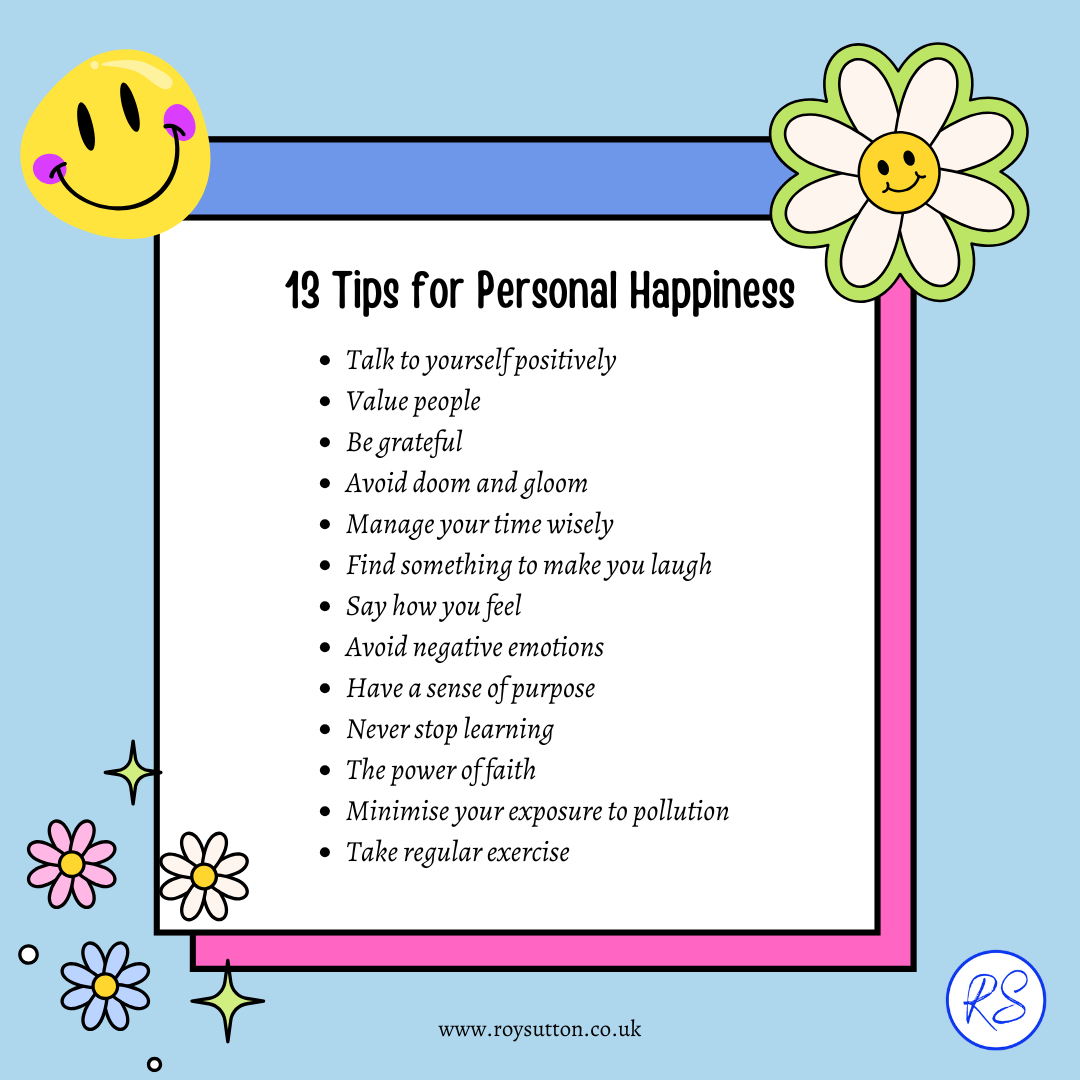
Here are 13 ways that will help you increase your sense of personal happiness and improve your life too:-

Tips for improving your personal happiness

1. Talk to yourself positively:

One of the greatest contributors to unhappiness is what’s going on in our heads.

Everyone is prone to self-doubt and feelings of not being quite good enough.

Everyone worries about being found out in their job.

It’s easy to assume that in some way you’re not very good at what you do and you think eventually someone will notice. Have you had that experience dear reader?

We all struggle to appreciate that we’re actually better than we think we are and that if we really couldn’t do the work for which we are paid, someone would have noticed already and they would have said something.

Negative self-talk can grind you down. So, stop it now.

Replace negative self-talk with positive self-talk.

Tell yourself constantly that you’re better than you think you are and that you have every reason to like yourself.

And adopt this saying as your mantra:

Repeat it to yourself frequently and whenever even the slightest hint of doubt pops into your mind.

2. Value people:

Your social network, i.e. the people with whom you interact, and your relationships are essential to your happiness.

Human beings are social animals. We’re not solitary creatures like cats. We need other people, frustrating as some of them can be at times.

Remember we’re all different. We’re all individuals. So accept people for who they are and what they are. Everyone has many sides to their personalities. No one is perfect.

So look for the good in people and don’t judge their less flattering sides too harshly. Never forget, we all have a less flattering side.

However, keep away from personality clashes and arguments. Let go of any resentment you may feel towards individuals. Just remember they’re not perfect, just like you.

If an argument seems inevitable, seek first to understand and then to be understood.

By understanding the other person’s point of view and why they feel the way they feel, you just might find you get along with them so much better.

And even if after you’ve listened carefully, if you still think they’re wrong, so what?

You can always agree to disagree.

You don’t have to prove you’re right and they’re wrong.

It doesn’t have to be about you proving you’re right all the time.

Peace and harmony are of much greater value to your happiness than being proved right.

So just let it go. 

3. Be grateful:

Being grateful for whatever you have, is an important part of your happiness.

Being thankful is a great attitude to develop.

If you think about it, I’m sure there will be at least as few things for which you can be truly thankful. Simple things like having a laugh with a friend whilst having a coffee or a meal.

They don’t have to be big things.

Little things that put a smile on your face are far more important to your personal happiness than any amount of material possessions.

In fact, material possessions don’t make you happy at all. Mostly the resulting clutter they create is just a source of stress and extra work.

Take the time to thank those people who provide you with even the smallest things. Making a point of saying thank you will help you realize just how abundant your life is in reality. 

4. Avoid doom and gloom:

The media tends to focus on bad news.

Unfortunately, bad news attracts more attention than good news and media channels are focused on ratings. They make money from eyeballs watching and ears listening.

They’re in the business of making money not cheering you up, so they’ll focus on bad news always.

It is a fact that most news is depressing and stressful.

With 24-hour rolling news channels, our lives are filled with a lot of stuff that can fill us with doom and gloom, if we’re not careful.

Watching, listening to, or reading the news will detract from your personal happiness.

So, if the news is just a source of doom and gloom then it’s a good idea to get less of it, don’t you think?

Switch it off and find something else to do that will cheer you up.

5. Manage your time wisely:

Your time is precious and it should be used and managed wisely.

Just because someone expects a piece of your time doesn’t mean they’re entitled to it.

Only you can judge whether they’re worthy of your time. And it’s perfectly reasonable to say “No!” if you think that’s appropriate.

No one has an unlimited amount of time. We all have just 168 hours per week. So we all must make the most of our time because time is far too important to waste.

If someone requests a piece of your time then make sure they have a very good reason to justify it. Otherwise, just say No politely but very firmly.

It’s your life, so live it your way. 

6. Find something to make you laugh:

Let’s face it, life is far too short to be serious all the time.

Occasionally we need to laugh to alleviate our stress levels.

Laughter is the best medicine, or so they say. And I think it’s true. A good laugh can cheer you up.

So make sure you enjoy a good laugh at least once a day. It may be watching a sitcom you love or a funny animal video on YouTube. Whatever puts a smile on your face then that’s fine. You need to smile because it will help you relax.

It may be a funny joke that makes you laugh.

And if that happens, remember to share the joke with family and friends. That way you get to laugh twice. Once when you hear the joke and again when you share it.

Laugh and laugh vigorously every single day. 

7. Say how you feel:

If people matter to you then be sure to let them know occasionally.

Don’t be afraid to communicate your feelings, affections, friendship and passion to people around you.

Being open about your feelings is not a sign of weakness, it’s a sign of strength.

It’s a sign that you’re confident enough in yourself to let people know what they mean to you.

It’s a sign that you recognize how important it is for people to know that they matter to you. They’ll appreciate it and that will enhance the bond between you. 

8. Avoid negative emotions:

Pent-up feelings of anger and frustration are bad for your health.

Yes, we all feel angry occasionally but suppressing it is counter-productive.

If you’re not happy about something it’s better to say so.

Occasionally you may need to say so forcefully too. However, never say it in a way that’s mean and hurtful. That’s just being unpleasant.

And if you do say something which you later recognize as mean and hurtful then apologize. Never be afraid, or too proud, to apologize.

You won’t be the first person to say something you later regret but don’t compound the offence but failing to offer a sincere apology.

At the very least that will show you’re big enough to recognize when you’re in the wrong.

If you can learn to express your anger and frustration in a way that will not cause injury or hurt to anyone then you’ll be on the road to being a very decent human being. 

9. Have a sense of purpose:

It’s important to have a sense of purpose.

To work each day at something in which you excel and which gets you out of bed in the morning.

Working hard at something you love can bring you great personal contentment.

Your work is your contribution to society and potentially the legacy you leave behind.

For instance, John Lennon left a wonderful collection of songs that we still listen to today almost 40 years after his death. That’s a fantastic legacy.

Work gives you a sense that you can finish tasks.

Work is a source of satisfaction when you take on a challenge and use your skills and know-how to complete it. In this way, you grow in character.

Through your work, you use your time profitably and when the working day is done you feel you’ve earned your rest and recreation.

Work well done, with a sense of purpose, will make you feel good about yourself. 

10. Never stop learning:

Learning does not finish when you leave school or college. Learning is a lifelong process. And it does not necessarily involve formal tuition.

You can be self-taught and learn by doing.

You can read books and watch instructional DVDs or video tutorials on YouTube.

You can listen to audiobooks and podcasts in your car or whilst travelling on public transport.

So be a committed student and work constantly on being a master of your craft.

Working constantly on achieving mastery will increase the value you can offer in the workplace and it will make you a very attractive proposition in the job market.

Learning is a joyful exercise, particularly if it’s a subject you love.

The more you learn, the greater will be the number of skills you can offer. The more skills you have the more value you add. So, learn something new every day.

And remember; learning will also broaden your horizons. Learning is a positive experience, so never stop learning. 

11. The power of faith:

Faith can be a great comfort in times of trial. Believing there is some higher power helps us to appreciate our place within the universe. We are nothing more than specs of dust in a great cosmic cloud, or at least that’s the way it seems.

Faith adds discipline to your life. Whichever faith you choose is not important. Well, I don’t think so anyway. However being part of a spiritual group with its singing, sacraments, chanting, prayers and meditations encourages inner peace and personal well-being.

It also encourages the idea of service and putting others first.

Never underestimate the power of faith. 

12. Minimise your exposure to pollution:

Pollution comes in many forms but it all takes its toll on your happiness and well-being.

Life is full of toxins, hazardous places, loud noises, light pollution and much more.

Minimize your exposure to these negative elements because they’re an assault on your senses and they’re not good for you if you’re over-exposed to them. 

13. Take regular exercise:

A sedentary lifestyle is not healthy for anyone.

Our bodies were built for movement. So exercise daily.

That doesn’t mean you must go to the gym. Neither does it mean you must participate in formal sports teams or clubs.

You can exercise in simple ways like running, jogging, a brisk walk or even an informal game of football or tennis with friends in the local park.

Even if you’re just taking your dog for a walk then that’s exercise too.

Alternatively, perhaps you could walk to and from work, if possible, rather than using your car or public transport.

Just do what your body was made for and you will feel a bit more alive. Regular exercise improves your health and well-being.

Conclusion:

Today’s underlying message is that you can choose to be happy or not. It all depends on how you choose to look at life and the slings and arrows that life sends your way.

There’s nothing to be gained by being miserable and a sense of personal happiness is better for your health and well-being.

So choose to be happy and develop habits that will lead you to a state of personal happiness.

It’s not easy of course, and it does take some work but it’s well worth the effort.

Please share this post with your friends:

If you found this blog post interesting and useful then please share it on social media with your friends. When you share, everyone wins.

Please share it now and I’ll be ever so grateful. You’ll be helping a keen blogger reach a wider audience.

Thank you for your support.

Other articles you might also find interesting:

4 cornerstones for how to speak so people will listen

How to speak so people will listen is a common challenge many of us face daily.

There’s an old saying that states that it’s not just what you say but the way that you say it.

And it’s very true: how something is said is as important as the words being spoken.

Now just think about that for a second. We can use the same words in different ways and deliver completely different messages.

How something is said also has an impact on whether people listen to us or not. We’ve all met engaging people who capture our attention, and we’ve all met a few boring people too, I’m sure.

In the video included here, Julian Treasure offers some excellent insight into how to speak so people will listen to you.

His underlying message in the video is that we must learn to speak with power to get our messages across to other people.

Julian Treasure suggests that there are several habits we must avoid if we are to speak with power.

He says in his view there are Seven Deadly Sins of Speaking, albeit he does note that this is not intended to be an exhaustive list. His deadly seven are as follows:

  1. Gossip: Speaking in an unkind way about other people.
  2. Judging: People are unlikely to listen if they feel they’re being judged.
  3. Negativity: It’s hard to listen to people with a negative attitude.
  4. Complaining: It’s hard to listen to a moaner too.
  5. Excuses: You won’t be taken seriously if blame is always elsewhere.
  6. Exaggeration: This can border on lying, and who listens to a liar?
  7. Dogmatism: Where facts are confused with opinions.

So, can we change if we suffer from all or some of these deadly sins?

Yes, of course, but it does take a little work and a better understanding of how improvements can be achieved.

Make Money

How to speak so people will listen:

In the video, Julian explains four cornerstones of powerful speech. He uses the mnemonic HAIL to explain these as follows:-

  1. Honesty: Being clear and straight
  2. Authenticity: Being real and being yourself
  3. Integrity: Being true to your word
  4. Love: Wishing people well. And we all like to be appreciated, surely?

However, understanding these cornerstones is only the beginning of the process because, as stated earlier, how you say what you’ve got to say is important too.

Julian then discusses aspects of speaking such as register, timbre, prosody, pace, pitch, volume, and the use of silence. To address many of these issues, you may need the help of a voice coach, of course, but knowing about them is a good start.

Julian also suggests some simple voice warm-up exercises for you to use before you give a speech. They’re so easy you can use them immediately.

This being a TEDTalk you’d expect this video to be both interesting and useful, and it doesn’t disappoint. I found Julian Treasure’s ideas fascinating, and if you’re someone who regularly speaks in front of an audience, large or small, then I am confident that you’ll find this video helpful.

This video has had over 22 million views on YouTube, so clearly, Julian Treasure’s ideas have resonated with a significant audience already.

Make Money

Please share this blog post:

If you found this blog post and the embedded video useful, then please share it on social media with your friends. When you share, everyone wins.

So go on, please share this blog post now, and I’ll be forever grateful. And you’ll be helping a keen blogger reach a wider audience.

Your support is appreciated, dear reader. Thank you.

Other articles you might also find interesting:

33 life lessons learned that are best learned early

Life lessons learned for most of us are learned the hard way. Here are 33 of those lessons that are best learned as early as possible, ideally in your teens or early 20s.

LIFE LESSONS LEARNED
Make Money

Life lessons learned:

1. On experiencing life:

Wherever you are, be there. Be present and experience the moment. You’ll remember moments with friends and family all your life, whereas you’re unlikely to remember social media posts moments after you’ve read them. No experience beats having a good laugh with your friends and family.

2. On making choices:

As an adult, you’re free to make your own choices but you must accept any consequences that follow. A wise adult learns to make good choices because the choices you make will dictate the quality of the life you lead. Your choices matter. Make too many bad ones and your life experiences won’t be very good at all.

3. On the future (1):

Where you’re going is more important than where you’ve been. The past was a series of lessons to be learned. The future is where you’ll spend the rest of your life. You can’t change the past but your future has yet to be written, and you’ve got the pen.

4. On the future (2):

The future is an endless stream of opportunities that you can choose to seize, or not. However poor your past may have been, that doesn’t mean you can’t seize new opportunities and exploit them to your own advantage. You can, with determination and hard work. And, never let anyone discourage you from having a go. Better to try and fail than to spend your life wondering what might have been

5. On asking questions:

Intelligent people ask questions. So, never be afraid to ask questions when you don’t understand something, or when you need clarification. Better to appear a fool momentarily than remain a fool permanently.

6. On attitude:

The greatest disability in life is a bad attitude. If you’ve got one you’d better change it, if you want your life to improve. Attitude matters. An average person with a positive attitude makes a much better employee than a genius with a chip on his or her shoulder.

7. On fairness:

Life isn’t fair. It never has been and it never will be. We’re all dealt a set of cards in life, and all we can do is play that hand as best as we can. We could get angry about the unfairness of it all or we can just get on and make the best of what we have. The latter approach is much easier on our nerves, in my experience.

8. On bullying:

When you’re having fun at someone else’s expense, remember it may be fun to you, and you may not mean any harm, but for the other person the impact of such an experience can be humiliating, upsetting, and it can cause significant, lasting and often permanent psychological damage to that person. So remember, it isn’t fun at all if it isn’t fun for the other person. If it isn’t fun for them, it’s just bullying. And if you’re bullying, you’re not being cool, you’re being nasty.

9. On judging others (1):

You’re free to judge others if you’re sure that you’re perfect in every way. If you conclude that you’re not quite perfect then why would you expect others to be?

10. On judging others (2):

For everyone, life is a struggle. No one is without problems, despite any external signs to the contrary. We just have to keep going for it’s the only way. Life goes on and we must too. If you’ve not walked two miles in someone else’s shoes, you’re not in a position to judge them. So, don’t.

11. On authenticity:

Authenticity is simply being who you are and not trying to be who you think you should be or who you think you’re expected to be. People will respect you for being who you are. An original is always better than a fake.

Make Money

12. On trust:

Trust takes years to build and seconds to break. And once broken the way you’re seen by others will never be quite the same again. Trust is a valuable commodity. Protect it.

13. On reputation:

Never underestimate the importance of your reputation. And if you wouldn’t be happy to read something about yourself on the front pages, don’t do it.

14. On communication:

If you want to tell anyone anything, speak softly and you’ll find that they’re much more likely to listen to you.

15. On success:

No one can ever be a failure but everyone can be a success. Failure is not a person it’s just an outcome you didn’t want. It’s also an opportunity to try again with greater knowledge and experience. Everyone can achieve some degree of success if they believe in themselves, they’re determined and they’re willing to work hard.

16. On priorities:

We all have the same amount of time. 168 hours a week. It’s how we choose to use it that dictates whether we achieve anything significant or not. Time is a resource, pure and simple. So, decide on your priorities and allocate your time accordingly. And just because someone wants a piece of your time, doesn’t mean you’re obliged to give it to them. If it’s not a priority, nor an obligation, just say NO.

17. On watching television:

Few people seem to recognise this but there’s a significant cost to watching television. Not the cost of purchasing the television set or any cable or satellite subscriptions you may have. The real cost is the opportunity cost of your time. That is the time you spend watching television. Time is money and you could be doing something more profitable with your time. Learning something new perhaps or running your own little income-generating side hustle.

18. On qualifications (1):

Most of the work done by most people in life doesn’t require a college degree at all. If you have one that’s great but stay humble. A motivated individual with common sense and decent reading, writing and arithmetic skills can succeed in life without one.

19. On qualifications (2):

You may need a college degree to work for an employer but you don’t need one to work for yourself. If it’s your business, you make the rules.

20. On qualifications (3):

Plenty of people graduating from Harvard will end up working for people who didn’t. So, stay humble. Studying at a top university is no guarantee for career success, nor does it guarantee wealth. A Harvard, Oxford, or Cambridge degree may look good on your CV but five years after graduation the only thing that will matter is what you’ve achieved in the workplace since.

21. On experience:

Doing is by far the best way to learn. The classroom is useful, of course, but nothing beats doing and learning from your mistakes. Making mistakes will teach you lessons that you’ll never forget. And learning from your mistakes will give you that valuable commodity known as experience. Knowing the theory is useful, whereas having experience is essential.

22. On employability:

You don’t sell who you are. You sell what you can do and the value you can add. Every job is about doing stuff for other people and delivering results. What is it you can do and what can you confidently deliver? Before you go for any job interview, make sure you have answers to these questions and make sure you can give examples of stuff you’ve delivered on previous occasions.

Make Money

23. On work (1):

Employers can quickly replace you with someone just like you and you’ll be forgotten quickly. So be professional in carrying out your duties, of course, but not at the expense of your interests or those of your loved ones.

24. On work (2):

Make sure you take good care of yourself. Employers will take everything you give and a bit more besides but if you died tomorrow your job would be posted online before your obituary. You’ll be replaced within days and the memory of your presence won’t last long.

25. On making money:

To make money you have to be doing stuff for other people. To make a serious amount of money you have to be doing stuff for multiple people simultaneously, even when you’re asleep. Sounds impossible but it can be done. For instance, serving the many with your digital products, sold online, can lead to great wealth.

26. On sales:

Successful selling is not about tricking people into buying something they don’t need. The art of selling is in proactively finding customers who’ve got problems for which your products can provide the ideal solution. If you can offer solutions to problems, you’ll find customers in need of what you have to sell. Find the right customers and a good product will sell itself.

27. On change (1):

It’s easier to remain as you are than it is to change but unless you change your life will not improve. Embracing change is hard but it is well worth the effort.

28. On change (2):

For things to change, you have to change. For things to get better, you have to get better. You can become more than you are but it won’t happen by accident. It all starts with you saying, I can; I will; and I won’t stop until I get there. And you must make any changes necessary.

29. On finding a life partner:

You’ll find, as you go through life, that Mr or Miss Perfect doesn’t exist. If you’re looking for a life partner, find someone whose faults you can live with. Yes, you’ll need to enjoy each other’s company. And yes, you’ll need to have things in common. However, everyone you meet will have faults of their own, even if they’re not immediately apparent.

30. On children (1):

When you have young children they need your attention much more than your mobile phone does. Your children should be your priority, particularly in the early years. You’re their role model. Be a positive role model and give them all the attention they deserve. The years pass quickly and your children, good or bad, are your legacy to the world.  Social media can wait. Anything less is simply a disservice to your child.

31. On children (2):

Children need continuity and they need boundaries. They need to be brought up with a set of values too. Fail to give them those things and you fail as a parent. Materialism is no substitute for the things that matter most.

32. On your social life:

You’ll never fit into every social group, nor should you try. Just focus on finding a group of people that are right for you. In other words, find your tribe. People that are welcoming to you, with interests like yours and personalities that appeal to you. It’s better to be in the company of people that appreciate your company, rather than trying to fit into groups that don’t want you there at all.

33. On experts:

There are plenty of people referred to as experts whose ideas and recommendations can prove to be stupid beyond belief. Listen to experts by all means but then use your own judgement. Don’t be fooled by people, just because they’ve got an impressive job title. If your instinct says they’re wrong, have the courage of your convictions and act accordingly. Just because an ‘expert’ said it, doesn’t mean you have to accept it.

Make Money

Please share this post with your friends:

If you found this article on life lessons learned useful then please share it on social media with your friends. When you share, everyone wins.

So go on, please share it now. If you can do that for me, I’ll be ever so grateful and you’ll be helping a keen blogger reach a wider audience.

And you’ll be helping your friends too. So you really can make a difference in the lives of others.

Thank you.

Other articles you might also find interesting:

How can I improve my self-discipline?

If you’ve been asking yourself, “How can I improve my self-discipline?” this article is for you.

Self-discipline is a key skill for reaching your goals and finding success in life. It helps you stay on track, avoid distractions, and progress even when you don’t feel motivated.

Many people struggle with self-discipline at times. That’s not unusual.

It’s normal to face challenges when trying to build new habits or break old ones.

However, the good news is that self-discipline can be strengthened like a muscle through consistent practice and the right strategies.

  • Setting specific, achievable goals helps build self-discipline and motivation
  • Creating a structured daily routine supports consistent progress toward objectives
  • Breaking tasks into smaller steps makes it easier to overcome procrastination and stay disciplined
MAKE MONEY MANIA

Self-discipline is a key skill for personal growth and success. It helps people reach their goals and overcome challenges. Learning about self-discipline can make it easier to put into practice.

Self-discipline involves using mental resources to control thoughts and actions. It requires self-awareness and the ability to delay gratification.

People with strong self-discipline can resist temptations and stay focused on long-term goals.

Brain scans show that self-discipline activates the prefrontal cortex. This area manages planning and decision-making. Regular practice can strengthen these neural pathways over time.

Willpower is like a muscle that can be trained and improved. But it can also get tired, leading to ego depletion. This happens when mental energy runs low after extended use.

Setting clear goals is vital for self-discipline. Goals give direction and motivation. They help people stay on track when faced with distractions or setbacks.

Effective goals are: • Specific • Measurable • Achievable • Relevant • Time-bound

Writing down goals makes them more concrete. Breaking big goals into smaller steps makes them less daunting. Regular progress checks help maintain momentum and allow for adjustments.

Common obstacles to self-discipline include:

  1. Lack of clear goals
  2. Poor time management
  3. Procrastination
  4. Negative self-talk
  5. Environmental distractions

Recognizing these barriers is the first step to overcoming them. Self-awareness helps identify personal weak spots. Some people struggle with social media distractions. Others find it hard to say no to social invitations.

Developing strategies to address specific obstacles can boost self-discipline. This might involve using website blockers or creating a dedicated workspace.

Self-discipline is a skill that can be improved through practice and effective techniques.

By setting clear goals, developing consistent routines, and managing time wisely, anyone can enhance self-control and achieve more.

Setting clear goals is crucial for building self-discipline. Start by defining specific, measurable objectives. Break larger goals into smaller, manageable tasks. This approach makes progress easier to track and boosts motivation.

Prioritize consistency over intensity when working towards goals. Small, daily actions often lead to better results than sporadic bursts of effort.

Write down goals and review them regularly. This helps maintain focus and commitment.

Use SMART criteria: Specific, Measurable, Achievable, Relevant, and Time-bound.

For example, instead of “exercise more,” set a goal like “jog for 20 minutes three times a week for the next month.” This clarity makes it easier to stay disciplined and track progress.

Consistency is key to building self-discipline.

Create daily routines that support goals and promote good habits. Start small and gradually increase commitments as discipline improves.

Establish morning and evening routines. These bookend the day with structure and set a positive tone. Include activities like meditation, exercise, or reading to reinforce disciplined behavior.

Practice self-control regularly in small ways. This strengthens willpower for bigger challenges. For instance, make the bed every morning or always put dishes away immediately after meals.

Track progress using a habit tracker or journal. This visual record of consistency can be motivating and help identify areas for improvement.

Time-blocking is an effective strategy for improving self-discipline.

It involves scheduling specific tasks for set periods, reducing distractions, and increasing focus.

Start by listing daily tasks and estimating how long each will take. Assign each task to a specific time slot in the day. Be realistic about timing and include breaks.

Use a digital calendar or planner to create time blocks. Color-code different types of activities for easy visualization. Stick to the schedule as much as possible, but allow some flexibility for unexpected events.

Remove distractions during focused work periods.

Turn off notifications, close unnecessary browser tabs, and find a quiet workspace. This helps maintain discipline and improves productivity.

Review and adjust time blocks regularly. Learn from experience to create more accurate and effective schedules over time.

Self-control is a skill that can be strengthened through practice and specific techniques. It plays a key role in achieving goals and resisting temptations.

Start small to build your self-control muscle. Pick one habit to change at a time. This could be eating healthier or exercising more.

As previously stated, you must set clear, achievable goals.

Write them down and track your progress daily. This helps keep you accountable.

Create a routine and stick to it. Regular habits reduce the need for willpower by making good choices automatically.

Get enough sleep. Lack of rest can weaken self-control. Aim for 7-9 hours of sleep each night.

Practice mindfulness. Even 5 minutes of meditation daily can boost focus and self-regulation.

Use positive self-talk. Replace negative thoughts with encouraging ones. This builds confidence in your ability to resist temptations.

Visualize success. Picture yourself achieving your goals. This mental practice can strengthen resolve.

Practice cognitive restructuring. Challenge and reframe unhelpful thoughts that weaken willpower.

Plan for obstacles. Identify potential challenges and prepare strategies to overcome them.

Use “if-then” planning.

Create specific plans for how to act in tempting situations.

For example, “If I feel like skipping my workout, then I’ll go for a 10-minute walk instead.”

Building self-discipline often involves facing obstacles. Having strategies to deal with setbacks and create backup plans can help you stay on track.

To improve self-discipline, it’s important to identify common challenges. These may include procrastination, lack of motivation, or external distractions.

One effective strategy is to remove temptations. This could mean turning off phone notifications or clearing your workspace of distractions.

Setting small, achievable goals can help build momentum. Breaking larger tasks into smaller steps makes them feel less daunting.

It’s also helpful to track progress. Using a habit tracker or journal can provide motivation and highlight areas for improvement.

As suggested, practicing mindfulness can increase awareness of impulses and help resist them. Regular meditation or deep breathing exercises can strengthen this skill.

Having a backup plan is crucial for maintaining self-discipline when faced with unexpected challenges. It provides a safety net and keeps you moving forward.

Start by identifying potential roadblocks. Think about what might derail your efforts and plan how to handle these situations.

Create alternative routines. If your usual workout time is disrupted, have a quick home exercise routine ready.

Build a support network. Have friends or family members who can offer encouragement or help when needed.

Be flexible with your goals. If circumstances change, adjust your targets rather than giving up entirely.

Regularly review and update your backup plans. As you progress, new challenges may arise, requiring different strategies.

MAKE MONEY MANIA

Accountability partners and feedback play key roles in boosting self-discipline. These external supports can provide motivation and help track progress.

An accountability partner can greatly improve success rates for reaching goals. This person checks in regularly to ensure you’re staying on track. They offer encouragement and help you stick to your plans.

Choosing the right partner is crucial. Pick someone trustworthy and committed to your success. Set clear expectations together. Decide how often you’ll check in and what information you’ll share.

Use technology to stay connected. Apps and video calls make it easy to touch base, even from a distance. Share progress updates and discuss any challenges you face.

Implementation intentions can strengthen this partnership. Create specific “if-then” plans for potential obstacles. This prepares both you and your partner to handle setbacks.

Feedback is a powerful tool for improving self-discipline. It provides valuable insights into your progress and areas for growth.

Seek feedback from various sources. Ask friends, family, coworkers, or mentors for their honest opinions. Be open to both positive and negative comments.

Create a system for collecting feedback regularly. This could be through monthly check-ins or progress reports. Use surveys or questionnaires to gather specific information.

Act on the feedback you receive. Identify patterns in the comments. Use this data to adjust your strategies and behaviors. Celebrate your successes and learn from your mistakes.

Remember that feedback is a form of positive reinforcement. It can motivate you to keep pushing forward, even when things get tough.

Creating new positive habits is key to improving self-discipline.

Setting clear goals and taking small steps can lead to lasting change. By making specific plans and starting with easy actions, you can build momentum toward better habits.

Implementation intentions are detailed plans that specify when, where, and how you will act on your goals. They take the form of “If X happens, then I will do Y.” This approach makes it easier to follow through on good habits.

To create implementation intentions:

  1. Choose a specific habit
  2. Decide on a trigger (time, place, or event)
  3. Plan your exact response

For example: “If it’s 7.00 am, then I will meditate for 10 minutes in my living room.”

These plans reduce decision-making in the moment. They help people act on their intentions automatically, even when tired or stressed.

Starting small is crucial when building new habits. Baby steps make change less daunting and more achievable. They allow for quick wins, which boost motivation and confidence.

To take baby steps:

  • Break big goals into tiny, manageable actions
  • Focus on consistency rather than perfection
  • Gradually increase difficulty over time

For instance, to start exercising, begin with a 5-minute walk each day. As this becomes routine, slowly extend the time or add new activities.

Small, consistent actions can lead to significant changes over time. They help build the mindset and skills needed for larger challenges. By starting small, people can avoid overwhelm and create lasting habits.

Mindfulness and positive reinforcement play key roles in building self-discipline. These practices help increase self-awareness and create lasting behavioral changes.

Mindfulness helps people notice their thoughts and feelings without judgment. This allows them to make better decisions that support their goals. To practice mindfulness:

  • Take a few deep breaths when facing a challenge
  • Pay attention to the present moment
  • Notice physical sensations and emotions

Regular mindfulness practice improves focus and reduces stress. This makes it easier to stick to goals and resist temptations.

People can start with short 5-minute sessions and gradually increase the time. Consistency is more important than length.

Positive reinforcement helps build new habits by rewarding good behavior. This creates a positive association with self-discipline.

Some ways to use positive reinforcement:

  • Celebrate small wins
  • Treat yourself after completing a difficult task
  • Track progress and acknowledge improvements

It’s important to choose rewards that don’t undermine goals. For example, someone trying to eat healthier shouldn’t use junk food as a reward.

Positive self-talk also reinforces good habits. People should praise their efforts and progress, not just the results.

self-discipline

Self-discipline is a skill that can be improved through various strategies and techniques. It offers numerous benefits and can be applied in many areas of life.

Setting clear goals is key to staying disciplined. Break big goals into smaller, manageable tasks. Use a planner or app to track progress and stay organized.

Practicing patience is crucial. Remember that building discipline takes time and effort.

Students can improve self-discipline by creating a structured study schedule. They should set specific times for homework and stick to them.

Using rewards for completing tasks can boost motivation. Students might treat themselves to a fun activity after finishing an assignment.

Self-discipline helps people achieve their goals more effectively. It leads to better time management and increased productivity.

Improved self-control can result in healthier habits and lifestyle choices. Self-disciplined individuals often experience less stress and greater self-confidence.

Waking up early consistently to exercise before work shows self-discipline. Sticking to a healthy diet and avoiding junk food is another example.

Saving money regularly instead of making impulsive purchases demonstrates financial self-discipline. Completing household chores on schedule also reflects good self-discipline.

Setting clear, realistic goals is an effective technique. People should align these goals with their personal values.

Removing distractions from the environment can help maintain focus. Creating routines and habits around desired behaviors reinforces discipline over time.

People with ADHD can benefit from using visual aids like calendars or task lists. Breaking tasks into smaller, more manageable steps can make them less overwhelming.

Establishing a consistent daily routine can provide structure. Using timers for tasks can help with focus and time management.

MAKE MONEY MANIA

If you found this article useful, then please share it on social media with your friends.

When you share, everyone wins.

So go on, please share it now.

If you can do that for me, then I’ll be ever so grateful, and you’ll be helping a keen blogger reach a wider audience.

Thank you for your support.

Set SMART Goals: A Blueprint for Success

Setting goals is key to success, but not all goals are made equal.

This approach to goal-setting gives you a clear roadmap and helps you stay focused on what matters most.

SMART goals work for both personal and professional growth. They push you to think deeply about what you want to achieve and how you’ll get there. By breaking down big dreams into smaller, doable steps, SMART goals make your aims feel less daunting and more within reach.

Using the SMART method can boost your chances of meeting your goals. It helps you track your progress, stay motivated, and make adjustments as needed. Whether you’re aiming to improve your skills at work or make positive changes in your life, SMART goals can guide you to success.

Key Takeaways

  • SMART goals provide a clear, structured way to set and achieve objectives
  • The SMART method applies to both personal and professional goal-setting
  • Using SMART goals increases the likelihood of reaching your targets

Understanding SMART Goals

SMART goals provide a clear framework for setting and achieving objectives. They help people and businesses create plans that are easy to follow and measure.

Definition and Origin

SMART is an acronym that stands for Specific, Measurable, Achievable, Realistic, and Timely. This goal-setting method helps create clear and actionable plans.

The SMART criteria were first introduced in the 1980s. Management experts developed this approach to improve goal-setting in organizations.

SMART goals are:

  • Specific: Clearly defined and focused
  • Measurable: Progress can be tracked
  • Achievable: Within reach given available resources
  • Realistic: Aligned with broader objectives
  • Timely: Have a set deadline or timeframe

Benefits of SMART Goals

SMART goals offer several advantages for individuals and organizations. They provide structure and guidance, making it easier to turn ideas into action.

One key benefit is improved focus. SMART goals help people concentrate on what’s most important. This leads to better use of time and resources.

Another advantage is increased motivation. Clear, achievable goals give people something concrete to work towards. This can boost confidence and drive.

SMART goals also make it easier to track progress. The measurable aspect allows for regular check-ins and adjustments as needed.

Lastly, SMART goals improve communication. They provide a common language for discussing objectives and expectations within teams or organizations.

Specific

Making goals specific is key to success. Clear and detailed objectives help focus efforts and increase the chances of achievement. Let’s explore how to define clear goals and why being specific matters.

Defining Clear Objectives

SMART goals start with being specific. This means stating exactly what you want to achieve. Instead of saying “I want to get fit,” a specific goal would be “I want to run a 5K race in under 30 minutes.”

Specific goals answer these questions:

  • What do I want to accomplish?
  • Why is this goal important?
  • Who is involved?
  • Where will it take place?
  • Which resources or limits are involved?

By answering these questions, you create a clear picture of your goal. This clarity helps you stay motivated and on track.

Importance of Specificity

Specific goals are powerful tools for success. They remove confusion and provide a clear target to aim for. When a goal is vague, it’s hard to know if you’ve achieved it.

Specific goals also help with planning. They make it easier to break down big tasks into smaller steps. This breakdown allows for better tracking of progress.

Research shows that specific goals lead to better performance. They help people focus their efforts and persist in the face of challenges. Vague goals, on the other hand, can lead to frustration and giving up.

Measurable

Measurable goals allow you to track progress and know when you’ve achieved success. Setting clear metrics and using the right tools helps you stay on track.

Establishing Metrics for Tracking Progress

To make goals measurable, set specific numbers or percentages. For example, “increase sales by 15%” is more measurable than “boost sales.”

Use these types of metrics:

  • Quantity: Number of items sold, customers served, etc.
  • Quality: Customer satisfaction scores, error rates
  • Time: Project completion dates, response times
  • Cost: Budget targets, revenue goals

Break big goals into smaller milestones. This makes progress easier to measure along the way. For instance, if aiming to gain 1000 new customers in a year, set monthly targets of about 83 new customers.

Tools for Measurement

Many tools can help track goal progress. Choose ones that fit your goals and work style.

Digital options:

  • Spreadsheets for data entry and calculations
  • Project management software to monitor tasks and deadlines
  • Analytics platforms for website or social media metrics

Physical tools work too:

  • Wall charts or calendars to mark milestones
  • Notebooks for daily progress notes
  • Whiteboards for team goal tracking

Pick tools that make data easy to record and review. Regular check-ins help spot issues early. Daily, weekly, or monthly reviews keep goals on track.

Remember to adjust metrics if needed. As you learn more, you may find better ways to measure success.

Achievable

Setting achievable goals is crucial for success. It involves assessing your capabilities and resources realistically while still pushing yourself to grow.

Setting Realistic Standards

Realistic goals take into account your current skills and situation. Look at your past accomplishments to gauge what you can achieve. Break big goals into smaller steps.

Achievable goals are challenging but possible. They stretch your abilities without being impossible.

Consider your available time, money, and other resources. Be honest about potential obstacles.

Get input from others who know your field or situation. Their perspective can help set realistic benchmarks.

Balancing Ambition and Practicality

Ambitious goals inspire growth, but must be grounded in reality. Aim high while keeping expectations reasonable.

Start with moderately challenging targets. As you gain confidence and skills, gradually increase difficulty.

Review your goals regularly to ensure they remain achievable. Adjust if circumstances change or you encounter unexpected barriers.

Celebrate small wins along the way. This builds momentum and motivation for bigger achievements.

Learn from setbacks. Use them to refine your approach and set more accurate goals in the future.

Relevant

Goals need to matter and align with your broader objectives. The right goals push you forward and connect to your values and vision.

Aligning Goals with Values

Relevant goals match your personal or company mission. They fit with your core values and long-term plans. Think about why each goal matters to you.

Ask yourself: Does this goal help me grow? Will it make a real difference? Does it excite me?

Goals that align with your values are more motivating. You’ll work harder to reach them. They give your efforts more meaning and purpose.

Consider how each goal fits into the bigger picture of your life or work. Make sure it takes you in the direction you want to go.

Ensuring Goal Relevance in Changing Environments

Goals need to stay relevant as things change. What matters today might not matter tomorrow. Review your goals often to make sure they still fit.

Be ready to adjust goals when needed. New information or events might shift your priorities. It’s okay to change course if a goal no longer makes sense.

Keep an eye on trends in your field. Stay flexible and open to new ideas. This helps you set goals that keep you ahead of the curve.

Ask for input from others. They might see things you don’t. Fresh perspectives can help you spot new opportunities and stay relevant.

Time-Bound

SMART goals need a clear timeline for completion. Setting deadlines creates urgency and helps track progress effectively.

Defining a Timeline

Time-bound goals have specific deadlines. This helps people stay focused and motivated. When setting a timeline, consider these factors:

  • Project complexity
  • Available resources
  • Other commitments

Break larger goals into smaller milestones with their own deadlines. This makes progress easier to track.

Use a calendar or project management tool to mark important dates. Regular check-ins help ensure the goal stays on track.

Adapting to Time Constraints

Sometimes, unexpected events can affect a goal’s timeline. It’s important to be flexible and adjust when needed.

If a deadline seems unrealistic, don’t give up. Instead, try these strategies:

  • Reassess priorities
  • Seek additional resources
  • Modify the goal’s scope

Time-bound goals create a sense of urgency. This can boost productivity and motivation. However, be careful not to set overly aggressive deadlines that lead to burnout.

Regular progress reviews help identify if timelines need adjustment. This allows for timely changes to keep the goal achievable and relevant.

Writing SMART Goals

Creating SMART goals helps you set clear, achievable objectives. This method breaks down goals into key components and helps avoid common mistakes.

Formulating Effective Statements

SMART goals are Specific, Measurable, Achievable, Relevant, and Time-bound. To write a SMART goal, start with a clear action verb. Make it specific by answering who, what, where, when, and why.

Include a measurable element, like numbers or percentages. This makes progress trackable. Set an achievable target that challenges you but remains realistic.

Ensure the goal is relevant to your larger objectives. Finally, add a time frame to create urgency and accountability.

Example: “Increase monthly website traffic by 25% within 3 months by publishing 2 blog posts per week and optimizing 5 existing pages for SEO.”

Common Pitfalls to Avoid

Vague language is a major pitfall in goal-setting. Avoid words like “more” or “better” without specific metrics. Don’t set unrealistic goals that lead to frustration.

Forgetting to align goals with broader objectives can waste effort. Make sure each goal supports your overall strategy.

Neglecting to set deadlines often results in procrastination. Always include a clear end date.

Avoid setting too many goals at once. Focus on a few key objectives to maintain motivation and prevent overwhelm.

Lastly, don’t ignore the importance of regular review. Schedule check-ins to assess progress and adjust goals as needed.

Implementing SMART Goals

Putting SMART goals into action requires careful planning and ongoing management. Creating detailed action plans and regularly monitoring progress are key steps to achieving success.

Action Plans and Roadmaps

Developing an action plan is crucial for turning SMART goals into reality. Break down each goal into smaller, actionable steps. These steps should be specific tasks with deadlines.

Create a timeline or roadmap showing when each task needs to be completed. This visual aid helps track progress and keeps everyone aligned.

Assign responsibilities for each task. Clear ownership ensures accountability and prevents important steps from being overlooked.

Include necessary resources in the plan. Identify what tools, skills, or support are needed to accomplish each task.

Monitoring and Adjusting Goals

Regular check-ins are essential to track progress and make adjustments as needed. Set up a schedule for reviewing goals, such as weekly or monthly meetings.

Use measurable metrics to assess advancement. Compare current results to the initial targets set in the SMART goal.

Be prepared to modify goals if circumstances change. Flexibility allows for adapting to new information or unexpected challenges.

Celebrate milestones along the way. Recognizing progress boosts motivation and maintains momentum towards the final goal.

Examples of SMART Goals

SMART goals help people achieve success in various areas of life. These goals are specific, measurable, achievable, relevant, and time-bound. Let’s look at some real-world examples.

Personal Success Stories

Jane set a SMART goal to run a marathon within 6 months. She made a detailed training plan and tracked her progress weekly.

By breaking her goal into smaller milestones, Jane stayed motivated. She gradually increased her running distance and speed.

After 6 months of hard work, Jane completed her first marathon. Her success inspired her to set new fitness goals for the future.

Tom wanted to save money for a house down payment. He set a SMART goal to save $20,000 in 2 years.

Tom created a budget and set up automatic transfers to his savings account. He also found ways to increase his income through side jobs.

By tracking his progress monthly, Tom reached his savings goal on time. This allowed him to buy his first home.

Case Studies in Different Domains

In business, a small startup set a SMART goal to increase website traffic by 50% in 3 months. They focused on creating quality content and optimizing for search engines.

The team monitored their progress weekly using analytics tools. They adjusted their strategy based on the data. After 3 months, they exceeded their goal with a 60% increase in traffic.

In education, a high school set a SMART goal to improve student reading scores by 10% in one academic year. They implemented a new reading program and provided extra support for struggling students.

Teachers tracked student progress monthly. By the end of the year, the school achieved a 12% improvement in reading scores. This success led to setting new academic goals for the following year.

Reviewing and Reflecting on SMART Goals

Taking time to review and reflect on SMART goals is key for growth. This process helps identify what worked well and where improvements can be made. It also provides insights for setting future goals.

Evaluating Goal Achievement

To evaluate SMART goal achievement, start by comparing results to the original targets. Look at the specific metrics set and assess if they were met. For example, if the goal was to increase sales revenue by 10%, check if this number was reached.

Consider these questions:

  • Was the goal completed on time?
  • Were all parts of the goal achieved?
  • What challenges came up during the process?

It’s important to be honest about both successes and setbacks. If a goal wasn’t fully met, try to pinpoint why. This info is valuable for future planning.

Learning from the SMART Goal Process

Reflecting on the goal-setting process itself can lead to better goals in the future. Think about how well each part of the SMART framework worked.

Ask:

  • Was the goal specific enough?
  • Were the metrics chosen easy to measure?
  • Did the goal push you while still being achievable?
  • Was the goal relevant to broader aims?
  • Did the timeframe make sense?

Use these insights to refine your approach. Maybe you need to set more challenging goals next time. Or perhaps you should break big goals into smaller steps.

Remember, the point is to keep improving. Each SMART goal cycle should make you better at setting and achieving goals.

Frequently Asked Questions

SMART goals help people set clear, achievable targets. They improve planning and boost success rates in various areas of life.

What are the essential components of SMART goals?

SMART stands for Specific, Measurable, Achievable, Relevant, and Time-bound. These five aspects help focus efforts and improve goal-setting.

Specific goals clearly define what needs to be done. Measurable goals allow progress tracking. Achievable goals are realistic and attainable.

Relevant goals align with broader objectives. Time-bound goals have deadlines for completion.

How can one effectively apply the SMART framework in goal-setting for students?

Students can use SMART goals to improve their academic performance. They should start by identifying specific areas for improvement, like raising a grade in math.

Next, they can set measurable targets, such as increasing test scores by 10%. The goal should be achievable based on current performance and available resources.

It must be relevant to their overall education plan. Finally, they should set a deadline, like the end of the semester, to create urgency.

What are some best practices for defining measurable objectives in SMART goals?

Measurable objectives use numbers and data to track progress. One best practice is to choose clear metrics that quantify progress.

For example, “increase sales by 15%” is better than “boost sales.” Another tip is to use existing data as a baseline for improvement.

Setting milestones along the way helps monitor advancement. Regular check-ins ensure the goal stays on track.

How does setting SMART goals improve business planning and outcomes?

SMART goals enhance business planning by providing clear direction. They help companies focus resources on specific objectives.

These goals make it easier to track progress and adjust strategies as needed. Employees understand their roles better when goals are clearly defined.

SMART goals also improve accountability. Teams can celebrate achievements when they reach measurable targets.

Can you provide a clear example of a SMART goal for personal development?

A SMART personal development goal could be: “Read 12 non-fiction books in the next 12 months to expand knowledge in my field.”

This goal is specific (12 books) and measurable (one per month). It’s achievable with consistent effort and relevant to career growth.

The time-bound aspect (12 months) creates a sense of urgency and helps track progress.

What techniques can be used to ensure goals align with the SMART criteria in a work environment?

One technique is to use goal-setting worksheets that prompt employees to address each SMART criterion.

Another approach is to have team discussions to refine goals collectively. This ensures goals are realistic and align with company objectives.

Regular goal reviews help maintain SMART alignment. Adjusting goals as circumstances change keeps them relevant and achievable.

Please share this post with your friends:

Did you find this article interesting and useful?

If so, then please share it on social media with your friends. When you share, everyone wins.

So go on, please share it right now. If you do, I will be ever so grateful, and you’ll be helping a keen blogger reach a wider audience.

Thank you for your support.

Copyright © Mann Island Media Limited 2024. All rights reserved.

The importance of teaching children about money

Teaching Children About MoneyThe importance of teaching children about money is not something that’s taken as seriously as it should be, in my opinion.

Certainly not in the education system. As far as I can see, financial education for children and young adults is rarely covered within the education system at all. It wasn’t when I was young and it isn’t now.

Some might say that money’s not the most important thing in life and philosophically that may be true.

However, money’s up there with oxygen and water when it comes to sustaining human life. In the modern age, life revolves around money, whether we like it or not.

Money’s a measure of the value we add to the lives of others and it’s also the oil that lubricates human existence.

Without money, living would be virtually impossible for almost everyone today.

1. The point of teaching children:

The point of teaching children is to prepare them for adult life, surely?

Our aim should be to equip them with everything they need to know, so they can function effectively as adults once they leave the education system.

Now reading, writing and arithmetic are all essential subjects, of course, because you can’t get too far in the world of work without these basic skills. And it’s through work that we really add value and maximise our income.

Nevertheless, where I believe the education system generally fails children and young people is the omission of the teaching of essential life skills, like earning an income and managing money. Important subjects like money and personal finance are never covered at all, certainly not in any significant way.

2. Money and personal finance:

To me, it’s surprising that we don’t teach our children about money or personal finance in their formative years.

Surely whilst at school, children should learn about:-

          • The way money is earned;
          • The way to manage money;
          • How to budget, so they can pay their bills; and
          • How to spend their money wisely.

Children should also learn about how they should prioritize expenditure to avoid getting themselves into a financial mess, in my opinion.

3. The pros and cons of debt:

Personally, I think that children and young adults should learn about the pros and cons of debt.

They should learn about the difference between secured and unsecured debt, given the impact these factors will have on the interest rates that will be applied to such debt.

Young people should learn about the power of compound interest too. Not so much as a mathematical exercise but in terms of how it can quickly turn a relatively small debt into a very large debt if we’re not careful.

And they should also learn to appreciate that credit cards are not just a convenient means for cashless payment.

Used thoughtlessly, credit cards can result in personal wealth destruction and excessive levels of expensive debt.

Children and young people should know that credit cards are a form of unsecured debt, which means they come with very high rates of interest, which accelerate a personal debt mountain rapidly, if not paid off immediately once the bill arrives at the month-end.

4. Interest rates matter:

Everyone should know that interest rates really do matter. They’re very significant and shouldn’t be treated lightly.

Children and young adults should learn that they should never go into debt for the purchase of discretionary items. It’s always better that they save up for that discretionary purchase before they buy, of course.

5. The nature of work:

Every young person should learn about how work is just doing stuff for other people in exchange for money and that the more value they can add through their skills and know-how, the more they’ll earn throughout their life. So skills matter too.

Everyone should be taught about the economics of supply and demand and their impact on pricing.

Kids should understand the difference between trading their time with one employer for a wage and the opportunity to serve multiple customers through their own business and their own creativity.

If they have the ability to create products which solve problems for customers, then they have the potential to make a lot of money.

Essentially kids should learn to appreciate the difference between employment and self-employment.

6. The road to financial freedom:

Young people should learn about wealth, pensions and how to achieve financial freedom through putting money aside on a regular basis and investing it wisely.

They should be positively encouraged to work towards achieving financial freedom.

Once they’re financially free they can focus on doing things they enjoy doing rather than things they have to do, because they’ve no other choice.

If nothing else, this makes the goal of achieving financial freedom a worthy aim, in my opinion.

7. The impact 0f inflation, taxation and government borrowing:

Kids should learn about the impact that inflation will have on the value of their money and how this can affect their savings, particularly in old age. They should also be taught about risk and its relationship with reward.

They should learn about taxes and how the money they pay in taxes will be spent, and frequently squandered by the government.

Everyone should know that there’s no such thing as government money, only taxpayer’s money. Our money!

Children and young people should know that it’ll be their hard-earned money that’s being spent by the government.

They should also know that when governments borrow money this is simply a means for spending today and then passing the bill on to future generations. In other words, our children and grandchildren, and indeed their children, will pay the bill for today’s government borrowing. Potentially, future generations could be impoverished by excessive government borrowing today.

Government borrowing is not a free lunch. Someone eventually must bear the interest payments in future years, as well as the repayment of the original capital sum that was borrowed. And don’t forget, governments are borrowing money continually.

8. Holding government to account:

Children should be taught to question how their money is being spent by the government and how to register their disapproval if they’re not happy with what’s being done with that money, in their name.

9. Money matters:

teach children about moneySadly most people have little real understanding of money, which means that they’re easily conned by sharp business practices, particularly in Financial Services, and by politicians driven only by their own self-interest.

Perhaps that’s why schools are not encouraged to teach personal finance as a subject.

Parents should demand that their children are taught about money, in my opinion.

If the education system fails children by not teaching them important life skills then, as parents, we must shoulder at least some of the blame, surely?

And as always, we’ll get what we tolerate.

For me, teaching children and young people about money is an issue for the education system, as much as it is for parents themselves.

Money really does matter and, in my opinion, we fail children and young people if we don’t provide them with the know-how and skills to make the most of it throughout their lives.

Please share this post with your friends:

If you found this article useful and interesting then please share it on social media with your friends. When you share, everyone wins.

Please share it now and I’ll be ever so grateful. You’ll be helping a keen blogger reach a wider audience.

Thank you for your support.

Articles that might also appeal to you:

Copyright © Mann Island Media Limited 2024. All rights reserved.
The importance of change and the opportunities it brings

Today, dear reader, I’d like to explore the importance of change to a business and the opportunities it brings. For the fleet-footed entrepreneur, opportunity is synonymous with change. If that isn’t obvious, trust me, it’s true. And that’s why it’s important to embrace change.

1. Change is inevitable:

As the old saying goes, change is inevitable, except from a vending machine.

We cannot avoid change, quite simply, because it’s going to happen whether we like it or not. Trying to stop it is like trying to hold back the tide. It cannot be done. Change is simply a force of nature.

However, if you hate change, don’t worry because you’re not alone. Most people hate change.

Just when we think we have everything under control, a significant change happens and suddenly we’re scrambling to get ourselves back to equilibrium. It makes life seem like a giant game of Snakes and Ladders, doesn’t it?

2. Fear of change is natural:

Actually feeling uncomfortable when faced with change is both rational and natural because one of the most basic human needs is the need to feel secure. Change is an uncomfortable experience because it makes us feel insecure.

However, we must control any fear we have about it and we must have the courage to do whatever is necessary to ensure that we respond appropriately as the winds of change start blowing around us.

3. Businesses can be fragile:

Change can affect a business in many ways, given that plenty of things can change for a business over time.

For instance, consumers’ needs, wants, and expectations will change over time, as will technology; markets, competition, and regulations. And of course, let’s not forget taxation. Governments are constantly tinkering with taxation, as their need for money increases.

Therefore, business owners and executives must be on their guard constantly, anticipating change and how it might affect their business.

Whether you’re an owner, an executive or just an employee, if you’re involved with a business then you cannot afford to become too complacent.

Ignore change and it’ll kill your business quicker than you might imagine. It can kill your career, too. Businesses can be fragile if they’re exposed suddenly to the harsh reality of change.

4. Change on an industrial scale:

It’s easy to think that major corporations that dominate whole industries are immune from the impact that change can bring. Unfortunately, this isn’t so.

Consider, for instance, the computer industry.

IBM was once the behemoth of that industry. The very name was synonymous with everything that was best in the information technology (IT) sector, globally. So glowing was their reputation that there was an old saying universally accepted in business, “No one ever got fired for buying IBM.

They were Big Blue, second to no one.

However, their size and reputation didn’t stop them from almost paying a heavy price for failing to anticipate changing IT trends.

For years, IBM favoured large centralised computer installations that filled whole buildings. And IBM didn’t see any reason to do anything differently, as they were in the business of supplying these and making good money from them.

Neither did they believe that many people would actually need computers. As recently as 1943 Thomas Watson, then Chairman of IBM said, “I think there’s a world market for maybe five computers.

However, IBM’s lack of foresight didn’t end there.

Having introduced what we now call the PC to the market in 1982, they didn’t believe it had any real future. Apparently, their original forecast for global sales for the PC was just 25,000 units, worldwide.

IBM didn’t want PCs to sell because they saw centralised corporate computer systems as where the real money was. Their failure to see the potential of the PC allowed Microsoft to move in and become a dominant player at IBM’s expense.

Failure to recognize changing trends and how they would affect the demand for computers and the way computers were going to be used had almost catastrophic consequences for IBM.

To be fair, they did manage to adapt eventually, but not before their business came dangerously close to collapse. And to this day, they do not dominate their industry in the way they once did.

5. Heavyweights no more:

Another good example of a dominant industry player failing to recognise the winds of change was Digital Equipment Corporation (DEC).

If you’re not familiar with that name, dear reader, they were the leading supplier of what was then known as the mini-computer back in the late 1970s.

However, it seems DEC allowed its dominant industry position to cloud its judgment because back in 1977, Ken Olson, then President, Chairman, and founder of DEC observed, “There is no reason for any individual to have a computer in his home.

Where is DEC now?

They’re nothing more than a footnote in the history of digital technology. Few people, other than old computer industry hands, will even remember the name.

And yet the demand for computer technology products is greater than it has ever been. Every household has several of them in the form of desktops, laptops, and, in particular, tablets and smartphones.

Today, the computer industry is dominated by companies like Microsoft, Apple, and Google. None of these companies even existed when Ken Olson made his unfortunate comment in 1977.

Another good example is Kodak, once the dominant player in the photographic products industry. As recently as 1976, Kodak commanded 90% of film sales and 85% of camera sales in the United States. Where are they now? Certainly, nothing like the company they once were, that’s for sure.

6. Change brings opportunity:

Set aside the fear of change, and you’ll see that it’s not necessarily a bad thing, because it generates opportunities for the fleet-footed. So there’s a positive dimension to change as well.

If it’s embraced, then opportunities are always there for the taking.

Just think about it for a second. If change didn’t happen, we’d all still be living in caves and riding around on donkeys.

Most companies, particularly large corporations, are usually far too slow in responding to change. However, that offers plenty of scope for smaller, faster, and more flexible businesses to move in and relieve the big boys of their lunch.

So change is a positive dynamic.

7. See change positively:

Let’s face it if everything always remained the same, then most of the things we enjoy and take for granted today wouldn’t exist.

In developed countries, we enjoy a standard of living that would have been beyond the imagination of people even a century ago. Think about that statement for a second; everything we now take for granted today once didn’t exist.

The point is that we ignore change at our peril, particularly in business.

So it’s better to embrace change positively than to ignore it.

Yes, of course, it feels uncomfortable, but we all get used to changes in the fullness of time.

If change is going to happen anyway, then we might as well see what’s in it for us, surely?

If we’re in business, or indeed, as people, we should always be constantly thinking about how we can exploit change to our advantage. How can we seize the opportunities that will come along as a natural consequence of change?

To exploit change, we need to become trend-watchers. And not just single trends.

We need to be watching every trend that might have an impact on ourselves and our businesses.

We must consider how those trends might come together to create a perfect storm, the winds of which might do us harm or become the wind beneath our wings.

Whether the consequences are good or bad, we must always be ready for them.

9. Conclusion:

Successful people are adept at exploiting opportunities brought about by change.

Change is synonymous with opportunity, it’s that simple.

Never fear change, you must embrace it.

If success is your aim, then change can be your friend.

However, never underestimate the harm change can do, should you become too complacent.

Change can be a force for good, but equally, it can be a dangerous force for the unwary.

When you think of change, think positively, but think defensively too.

Please share this post with your friends:

If you found this article useful and interesting, please share it on social media with your friends. When you share, everyone wins.

Please share it now and I’ll be ever so grateful. You’ll be helping a keen blogger reach a wider audience.

Thank you for your support.

Copyright © Mann Island Media Limited 2024. All rights reserved.
Life is short: Here’s what’s important to you today

Life is short:

You’ll often hear people talk about the importance of money in terms of living life in the modern age.

Let’s be honest, it’s difficult to live without money today, is it not? Certainly, it’s up there with oxygen and water for sustaining life.

Nevertheless, we must also remember that life is short. And sadly for some people, it’s very short indeed.

So, while money’s important, it’s not an ideal means for measuring success, is it? Not real success in life anyway.

Misplaced priorities:

In the modern age, it’s easy to become obsessed with money.

However, the accumulation of money for its own sake should never be the underlying motive that drives us, surely? That can only lead to a life of misplaced priorities, I think.

If your approach to life includes an obsession with money, then you’ll be doomed to disappointment, and I think you’ll realise that eventually.

One day you’ll look back and wish you’d spent a bit more time with family, friends, and loved ones, of that I’m quite sure.

So what would be an ideal measure of success?

A measure of success:

For me, a better measure of success is whether we’re feeling fulfilled by what we’re doing.

If our work is something we’d do as a hobby if we couldn’t get paid for it then that’s a better way of gauging success. As the legendary investor, Warren Buffett once said, “Look for a job that you’d take if you didn’t need a job.”

A sense of purpose and work that is fulfilling and truly absorbing is a much less stressful way of living.

Enjoy what you do:

Enjoy what you do and do what you enjoy, if you possibly can.

If you enjoy what you do, you’ll do it well, and the money will follow anyway. If you do your work exceptionally well, then people will notice. And once you get noticed, you’re on your way to genuine success.

Never be driven by money alone.

Never accept a job simply because it’s well paid.

It’s nice to have a good salary, of course.

However, once you get used to the money, you still have to spend a third of your life doing the work for which you’re being paid well.

And doing work you don’t enjoy is a significant price to pay in terms of your emotions, stress levels, and the potential impact it will have on your health.

Time is precious:

If life’s short, then our time is very precious, surely?

What’s the point of working every hour you’ve got just to become rich, only to die suddenly of a heart attack having had no time to enjoy the fruits of your labour?

What a waste that would be. Being the richest man or woman in the graveyard is hardly a title worth having, is it?

So my underlying message to you today, dear reader, is to find work you enjoy doing and to make sure you leave a little time to enjoy life too. A little ‘me time‘ is essential for everyone.

No one’s life is perfect:

Don’t forget that everyone faces challenges, occasionally. No one’s life is perfect. We all have problems.

Inevitably, your life will have its ups and downs. However, make sure there are more ups than downs in your life, as far as you are able.

Take some time to smell the roses and have a laugh.

As the old Music Hall song used to say; “enjoy yourself, it’s later than you think.”

You wouldn’t want to live forever, but you should be living your life to the fullest today.

Life really is short and it’s definitely later than you think. And as we say where I come from, “you’ll be a long time dead.”

So go on, live life and live it now. And if you’ve yet to find work you enjoy doing, keep looking.

Please share this post with your friends:

If you found this blog post useful then please share it on social media with your friends. When you share, everyone wins.

Please share it now and I’ll be ever so grateful. You’ll be helping a keen blogger reach a wider audience.

Thank you.

Copyright © Mann Island Media Limited 2024. All rights reserved.

101 Quotes on self-improvement to inspire you

In seeking quotes on self-improvement, perhaps you’re looking for a better life.

Well, life doesn’t have to be as it is now. It can be something much closer to what you’d like it to be. And with a little effort on your part, you can make it happen.

Remember you’re not defined by your past. That serves only as a series of lessons. The future is yours to create and it all starts with self-improvement.

Self-improvement is just a process whereby you decide what it is you want; you decide what skills you’ll need to develop in order to get what you want; you work out how you can get those skills, and then you set some goals and start improving the quality of your life and that of your loved ones.

It can be done. People do it all the time. And so can you.

Learn more and you’ll earn more.

You’ll need a little inspiration to motivate you and keep you going. Motivational quotes are useful because they help you acquire ideas on getting started and they’re beneficial in helping you realize your dreams and goals.

So here are 101 quotes on self-improvement to inspire you and propel you along the road to make your dreams a reality.

Enjoy them all and please share them with your friends.

Quotes on self-improvement (1-20):

  1. Let us cultivate our garden. ~Voltaire
  2. If you can dream it, you can do it. ~Walt Disney
  3. Good things happen to those who hustle. ~Chuck Noll
  4. You will never win if you never begin. ~Helen Rowland
  5. If opportunity doesn’t knock, build a door. ~Milton Berle
  6. If you aim at nothing, you’ll hit it every time. ~Zig Ziglar
  7. All things are difficult before they are easy. ~Thomas Fuller
  8. The secret of getting ahead is getting started. ~Mark Twain
  9. Work harder on yourself than you do on your job. ~Jim Rohn
  10. He who conquers himself is the mightiest warrior. ~Confucius
  11. You just can’t beat the person who never gives up. ~Babe Ruth
  12. Believe you can and you’re halfway there. ~Theodore Roosevelt
  13. Set your goals high, and don’t stop till you get there. ~Bo Jackson
  14. Only I can change my life. No one can do it for me. ~Carol Burnett
  15. It is never too late to be what you might have been. ~George Eliot
  16. You cannot have a positive life and a negative mind. ~Joyce Meyer
  17. My purpose: to lift your spirit and to motivate you. ~Mavis Staples
  18. The dreaming has to be backed up by the doing. ~Carrie Wilkerson
  19. Problems are not Stop Signs, they are guidelines. ~Robert H. Schuller
  20. The only thing that overcomes hard luck is hard work. ~Harry Golden

Quotes on self-improvement (21-40):

  1. Nothing will work unless you do. ~Maya Angelou
  2. The only journey is the one within. ~Rainer Maria Rilke
  3. Either you run the day or the day runs you. ~Jim Rohn
  4. You don’t have to get it right the first time. ~Barbara Sher
  5. Life has no limitations, except the ones you make. ~Les Brown
  6. Without hard work, nothing grows but weeds. ~Gordon B. Hinckley
  7. Aim for the moon. If you miss, you may hit a star. ~W. Clement Stone
  8. The few who do are the envy of the many who only watch. ~Jim Rohn
  9. If you’re not doing what you love, you’re wasting your time. ~Zig Ziglar
  10. There is no such thing as failure. There are only results. ~Tony Robbins
  11. If you don’t like how things are, change it! You’re not a tree. ~Jim Rohn
  12. Don’t let someone else’s opinion of you become your reality. ~Les Brown
  13. Start where you are. Use what you have. Do what you can. ~Arthur Ashe
  14. The time is now. Stop hitting the snooze button on your life. ~Mel Robbins
  15. We will always tend to fulfil our own expectations of ourselves. ~Brian Tracy
  16. In order to succeed, we must first believe that we can. ~Nikos Kazantzakis
  17. It does not matter how slowly you go as long as you don’t stop. ~Confucius
  18. Life is 10% what happens to you and 90% how you react to it. ~Charles R. Swindoll
  19. A barrier is a limitation only when you perceive it as one. ~Stephen Richards
  20. When you have a dream, you’ve got to grab it and never let go. ~Carol Burnett

Quotes on self-improvement (41-55):

  1. The first step in solving a problem is to recognize that it does exist. ~Zig Ziglar
  2. Getting in touch with your true self must be your first priority. ~Tom Hopkins
  3. Too many of us are not living our dreams because we are living our fears. ~Les Brown
  4. You don’t have to be great to start, but you have to start to be great. ~Zig Ziglar
  5. The best preparation for tomorrow is doing your best today. ~H. Jackson Brown, Jr.
  6. Success is nothing more than a few simple disciplines, practised every day. ~Jim Rohn
  7. Setting goals is the first step in turning the invisible into the visible. ~Tony Robbins
  8. I never see failure as failure, but only as the game I must play and win. ~Tom Hopkins
  9. Perseverance is not a long race; it is many short races one after the other. ~Walter Elliot
  10. The difference between being mediocre and achieving excellence is you. ~Stephen Richards
  11. Become addicted to constant and never-ending self-improvement. ~Anthony J. D’Angelo
  12. The will to succeed is important, but what’s more important is the will to prepare. ~Bobby Knight
  13. If you always do what you’ve always done, you’ll always be where you’ve always been. ~TD Jakes
  14. How dare you settle for less when the world has made it so easy for you to be remarkable? ~Seth Godin
  15. You are essentially who you create yourself to be, and all that occurs in your life is the result of your own making. ~Stephen Richards

Quotes on self-improvement (56-70):

  1. Opportunity does not knock it presents itself when you beat down the door. ~Kyle Chandler
  2. Don’t compare yourself to others. Compare yourself to the person you were yesterday. ~Anonymous
  3. When you play it too safe, you’re taking the biggest risk of your life. Time is the only wealth we’re given. ~Barbara Sher
  4. Ever tried. Ever failed. No matter. Try Again. Fail again. Fail better. ~Samuel Beckett
  5. Decide what you want, decide what you are willing to exchange for it. Establish your priorities and go to work. ~H. L. Hunt
  6. You simply have to put one foot in front of the other and keep going. Put blinders on and plough right ahead. ~George Lucas
  7. Life is a gift, and it offers us the privilege, opportunity, and responsibility to give something back by becoming more. ~Tony Robbins
  8. I’ve found that luck is quite predictable. If you want more luck, take more chances. Be more active. Show up more often. ~Brian Tracy
  9. Knowing is not enough; we must apply. Willing is not enough; we must do. ~Johann Wolfgang von Goethe
  10. Change your life today. Don’t gamble on the future, act now, without delay. ~Simone de Beauvoir
  11. A strong, positive self-image is the best possible preparation for success. ~Joyce Brothers
  12. If you’re not making mistakes, then you’re not doing anything. I’m positive that a doer makes mistakes. ~John Wooden
  13. Believe that life is worth living and your belief will help create the fact. ~William James
  14. I can’t change the direction of the wind, but I can adjust my sails to always reach my destination. ~Jimmy Dean
  15. Perfection is not attainable, but if we chase perfection we can catch excellence. ~Vince Lombardi

Quotes on self-improvement (71-85):

  1. Don’t judge each day by the harvest you reap but by the seeds that you plant. ~Robert Louis Stevenson
  2. There’s only one corner of the universe you can be certain of improving, and that’s your own self. ~Aldous Huxley
  3. I hated every minute of training, but I said, ‘Don’t quit. Suffer now and live the rest of your life as a champion.’ ~Muhammad Ali
  4. Even if I knew that tomorrow the world would go to pieces, I would still plant my apple tree. ~Martin Luther
  5. Your present circumstances don’t determine where you can go; they merely determine where you start. ~Nido Qubein
  6. Put your heart, mind, and soul into even your smallest acts. This is the secret to success. ~Swami Sivananda
  7. Opportunity is missed by most people because it is dressed in overalls and looks like work. ~Thomas A. Edison
  8. Opportunities are usually disguised as hard work, so most people don’t recognize them. ~Ann Landers
  9. Nothing ever comes to one that is worth having, except as a result of hard work. ~Booker T. Washington
  10. Formal education will make you a living; self-education will make you a fortune. ~Jim Rohn
  11. Become addicted to constant and never-ending self-improvement. ~Anthony J. D’Angelo
  12. The major value in life is not what you get. The major value in life is what you become. ~Jim Rohn
  13. Outstanding people have one thing in common: An absolute sense of mission. ~Zig Ziglar
  14. It doesn’t matter where you are coming from. All that matters is where you are going. ~Brian Tracy
  15. If there is one lesson I’ve learned from failure and success, it’s this. I am not the outcome. I am never the result. I am only the effort. ~Kamal Ravikant

Quotes on self-improvement (86-95):

  1. You cannot change your destination overnight, but you can change your direction overnight. ~Jim Rohn
  2. Just don’t give up trying to do what you really want to do. Where there is love and inspiration, I don’t think you can go wrong. ~Ella Fitzgerald
  3. If you want to succeed you should strike out on new paths, rather than travel the worn paths of accepted success. ~John D. Rockefeller
  4. Time is more valuable than money. You can get more money, but you cannot get more time. ~Jim Rohn
  5. It is not as much about who you used to be, as it is about who you choose to be. ~Sanhita Baruah
  6. If you don’t design your own life plan, chances are you’ll fall into someone else’s plan. And guess what they have planned for you? Not much. ~Jim Rohn
  7. If you believe in yourself and have dedication and pride – and never quit, you’ll be a winner. The price of victory is high but so are the rewards. ~Bear Bryant
  8. My mission in life is not merely to survive, but to thrive; and to do so with some passion, some compassion, some humour, and some style. ~Maya Angelou
  9. No matter who you are, no matter what you did, no matter where you’ve come from, you can always change, and become a better version of yourself. ~Madonna
  10. We must all suffer one of two things: the pain of discipline or the pain of regret or disappointment. ~Jim Rohn

Quotes on self-improvement (96-101):

  1. If you want to be successful, find someone who has achieved the results you want and copy what they do and you’ll achieve the same results. ~Tony Robbins
  2. Learning is the beginning of wealth. Learning is the beginning of health. Learning is the beginning of spirituality. Searching and learning are where the miracle process all begins. ~Jim Rohn
  3. Move out of your comfort zone. You can only grow if you are willing to feel awkward and uncomfortable when you try something new. ~Brian Tracy
  4. You don’t get paid for the hour. You get paid for the value you bring to the hour. ~Jim Rohn
  5. Move out of your comfort zone. You can only grow if you are willing to feel awkward and uncomfortable when you try something new. ~Brian Tracy
  6. You are your greatest asset. Put your time, effort and money into training, grooming, and encouraging your greatest asset. ~Tom Hopkins

Please share with your friends:

So dear reader, did you enjoy these quotes on self-improvement? I do hope so.

If you did enjoy this post, then please share it on social media. When you share, everyone wins.

So go on, please share this post now and you’ll be making an old blogger very happy. Thank you.

Articles that might appeal to you:

Copyright © Mann Island Media Limited 2024. All Rights Reserved.

How to be happy and why you should be

How to be happy? Now, that’s a question I hear frequently.

Well, I believe that, if you’re going to be happy, then you need a sense of purpose.

Now just think about that for a minute. Your work takes up one-third of your life so surely it’s essential that you’re happy doing whatever you do?

So dear reader, if the question on your mind today is how to be happy in life then to find the answer it’s worth reflecting on your work for a moment and thinking about whether it’s right for you.

Does your work make you happy?

Do you believe your contribution to your job is something that only you can supply?

Would you say that your work is closely aligned with your natural talents?

If your job is a mismatch with their natural talents then you’re unlikely to do it as well as you might do otherwise. If you don’t do it well then it’s hard to feel a sense of pride in your work, surely? And, if you’re not doing it well, your boss is likely to be giving you a hard time too.

So in this scenario, you’re not going to be very happy, are you?

Let’s face it, spending your life doing something you don’t enjoy is such a waste, wouldn’t you agree?

You have so much natural talent that could be put to better use.

Yes, every job has its chores. Things you have to do which you hate but accept as part of the job. No job is perfect.

However, tedium should only be a small part of your whole work experience.

To feel happy and fulfilled doing the work you do means that you should enjoy at least 80% of your daily activity.

What happens if the job you do and your talents are mismatched?

Human beings are flexible and adaptable of course. So even in the worst job situations, people survive but at what cost to themselves?

How to be happy

The further you are from applying your natural talents and abilities, the less likely it is that you’ll enjoy your work in my experience. And being unhappy at work means you’re less likely to be happy in life. That’s a fact.

And if you’re not happy then it’s difficult to make a genuine contribution to life and the lives of other people. And this matters, particularly for those people who are your loved ones.

If your loved ones have to deal with someone who’s doing a job they don’t enjoy then it can make their lives miserable too. In fact, it can be no pleasure for anyone around you.

If you derive no pleasure from your work then life just becomes a grind. Also, it becomes stressful which is not very good for your health either.

The best and least stressful way to earn a living is by pursuing your interests and something which you both enjoy and which is compatible with your natural talents. This is the sweet spot and it’s how to be happy in life.

If society encouraged people to pursue their interests and work to their strengths, then we would not only be happier but we would become more productive.

And of course productive lives are happy lives too. We would all benefit and society would reap benefits too.

So think about what you enjoy doing and your natural talents, and then think about how you can best apply them.

It’s important to be happy doing what you do, but if you’ve yet to find work that makes you happy, then keep looking and don’t give up until you find it.

Please share this post with your friends:

If you found this blog post interesting and useful then please share it on social media with your friends.

When you share, everyone wins.

Please share this post now and I’ll be forever grateful. You’ll be helping a keen blogger reach a wider audience.

Thank you.

Copyright © Mann Island Media Limited 2024. All rights reserved.